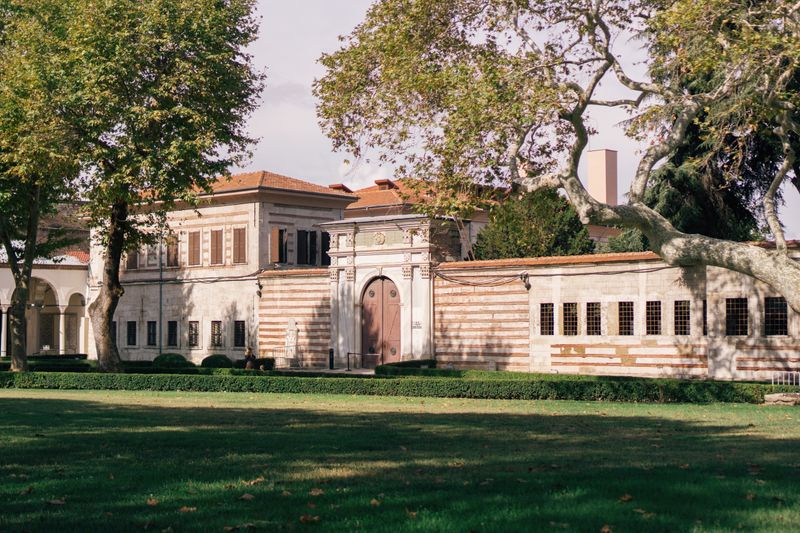
The Hospital of the First Courtyard of Topkapı Palace
The First Courtyard of Topkapı Palace was not merely a place for ceremonies, processions, and palace services. It also housed various institutions essential to the daily functioning of the imperial palace. One of these institutions was the palace hospital, located immediately to the right of the Imperial Gate (Bab-ı Hümayun).
In historical sources, the hospital is referred to as the Hastalar Odası (Chamber of the Sick) or Bimarhane (Hospital). Miniatures in the Hünername also depict this building as an important center providing medical care within the palace.
The Foundation of the Hospital: Mehmed II or Suleiman the Magnificent?
Historical sources offer differing accounts regarding which sultan originally commissioned the hospital.
The Italian traveler Menavino mentions that a hospital existed within the palace during the reign of Mehmed II (Mehmed the Conqueror), although he does not specify its exact location. A group of unidentified buildings shown to the right of the Imperial Gate on Vavassore's map of Istanbul may well have been this hospital.
The historian Ata attributes the hospital's construction to Mehmed II, whereas Mustafa Âli states that it was built during the reign of Suleiman the Magnificent.
Palace expenditure records dating from 1527–1528, during Suleiman's reign, refer to the building as Oda-i Mariz der Nezd-i Bab-ı Hümayun, meaning the Chamber of the Sick near the Imperial Gate. These records also mention a bathhouse belonging to the hospital, indicating that the institution was actively operating during this period.
It is therefore possible that the hospital already existed during the reign of Mehmed II and was subsequently reorganized, expanded, or developed under Suleiman the Magnificent.
Architectural Layout and the Hospital's Internal Organization
Historical bird's-eye views of the First Courtyard depict the hospital as a complex of buildings arranged around a central courtyard.
A schematic plan prepared by Bobovi in the 17th century reveals that the hospital was not simply a collection of randomly arranged rooms. Similar to the dormitories of the palace pages in the Third Courtyard, its rooms were organized according to the status and groups of the patients.
Abdullah bin İbrahim Üsküdarî, a 17th-century palace insider, also refers to the institution as the Bimarhane and Hastalar Odası (Chamber of the Sick). According to his account, separate rooms were allocated to different groups of palace pages to prevent them from mixing or interacting freely with one another. The hospital also had its own bathhouse.
This arrangement demonstrates that medical services at Topkapı Palace were not limited to treating illnesses. They were also integrated into the palace's strict hierarchy and highly regulated system of daily life.
Transporting Patients: The Red-Covered Hospital Cart
One of the most interesting details about the hospital concerns the special cart used to transport patients.
A miniature in the Hünername depicts a two-wheeled handcart covered with a red cloth. It was used to transport young palace pages who fell ill in the dormitories of the Third Courtyard to the hospital in the First Courtyard. The miniature also shows a person operating the cart, accompanied by two assistants.
The hospital was supervised by a eunuch official, who was also responsible for the wood storehouse located opposite the building. His presence in front of the hospital during meetings of the Imperial Council (Divan) provides further insight into his administrative responsibilities within the palace.
However, this hospital cart is particularly fascinating not only because of its medical purpose but also because of what it reveals about the hidden social life of Topkapı Palace.
Was the Hospital a Secret Gateway to the Outside World?
Life for the palace pages, known as içoğlanları, was governed by strict regulations. Their contact with the outside world was carefully restricted, and they were not free to meet relatives, friends, or former acquaintances whenever they wished.
According to accounts by Bobovi and Abdullah bin İbrahim Üsküdarî, some palace pages found a way to circumvent these restrictions by turning visits to the hospital into an opportunity for social contact.
Young men who were not actually ill sometimes pretended to be sick so that they could be transported from their dormitories to the hospital. By bribing the attendants responsible for carrying them, they could persuade them to move the cart more slowly through the First Courtyard.
This gave them an opportunity to exchange a few words with acquaintances from outside the palace.
Üsküdarî further explains that these encounters, referred to as Mülâkât-ı Araba, could even be continued in the hospital superintendent's room in exchange for an additional payment.
These accounts reveal how people living under the highly controlled conditions of the Ottoman palace occasionally developed creative ways to bypass its strict rules.
The Hospital's Location and Its Changing Role
The hospital's location in the First Courtyard, away from the dormitories of the palace pages in the Third Courtyard, is noteworthy. One possible reason for this arrangement was to prevent contagious diseases from spreading to other parts of the palace.
Nevertheless, the hospital's position in the First Courtyard also created an unexpected situation. For young men whose contact with the outside world was restricted, the institution gradually became a convenient meeting place.
Several 17th-century writers describe how the hospital's original medical function gradually changed. According to their accounts, it became a place where patients received treatment accompanied by music, while young palace pages used it to meet friends, secretly drink wine, and escape the strict discipline of their dormitories.
The historian Mustafa Âli even criticizes Suleiman the Magnificent for locating the hospital in one of the most accessible courtyards of the palace. In his opinion, this location made it easier for the palace pages to establish contact with people from outside, thereby undermining palace discipline and moral standards.
The Human Side of Topkapı Palace
The hospital in the First Courtyard of Topkapı Palace is an important institution that reminds us that the palace was not exclusively a center of government, political administration, and magnificent imperial ceremonies.
It provides valuable insight into how healthcare was organized within the Ottoman palace, how patients were separated according to their social status, and what responsibilities palace officials assumed in their daily duties.
Yet the historical significance of this building extends far beyond its medical function. Accounts from the 17th century reveal the social relationships, desire for freedom, and everyday experiences of young men living within the strict regulations of the imperial palace.
Today, when walking through the First Courtyard of Topkapı Palace, remembering this hospital helps us understand that the palace was not simply the world of sultans, statesmen, and foreign ambassadors. It was also home to hundreds of people who lived, worked, suffered illnesses, and created their own small worlds within its walls.
Where Was the Palace Hospital Located? A Visitor's Guide
As you enter Topkapı Palace through the Imperial Gate (Bab-ı Hümayun), take a moment to look toward the right-hand side of the First Courtyard. This is the area where the palace hospital once stood, close to the entrance but separate from the main residential quarters of the palace. Although the original hospital buildings no longer survive in their historical form, understanding their location helps visitors imagine how the palace functioned as a self-contained world, with its own healthcare facilities, service buildings, kitchens, and administrative departments. As you walk through this courtyard, remember that beyond the grand ceremonies and imperial processions, this was also a place where palace residents received medical care, met their acquaintances, and experienced the everyday realities of life behind the walls of the Ottoman court.
Last Modification : 11/14/2026 3:07:56 AM