The Night Visit to Ephesus
Where Light and Shadow Meet
As the sun withdraws from the marble colonnades of Ephesus, one of the most magnificent port cities of the ancient world, the city assumes an entirely different identity. The oppressive heat of the day and the clamor of tourist crowds give way to a gentle breeze and an eerie silence. It is precisely at this hour that night visits begin, offering visitors not merely a touristic activity, but a profound intellectual experience—a journey through time itself. But is wandering through a millennia-old ancient city in the darkness of night pure romanticism, or is it a deep and rational choice? This essay will explore the logical foundations of night visits to Ephesus, their impact on our perception of historical fabric, and the criticisms directed against this practice.
The Reconstruction of Perception and Practical Benefits
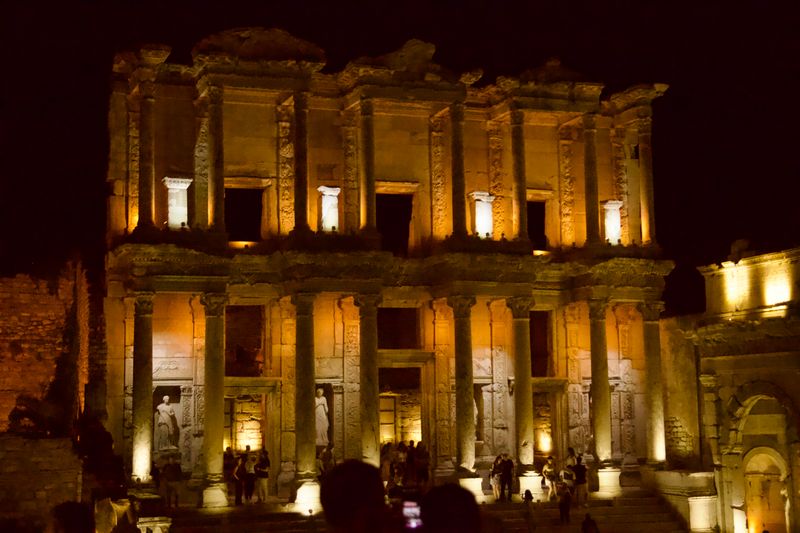
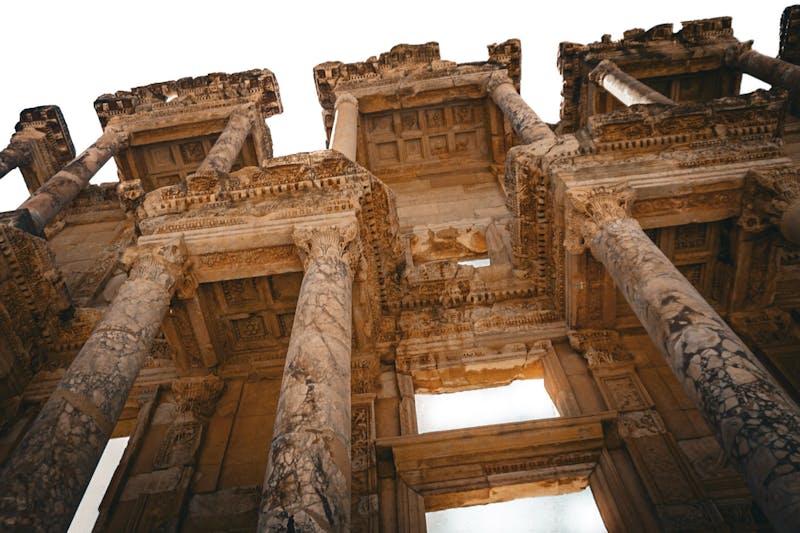
Understanding an ancient city is not merely a matter of seeing it with one's eyes; it requires feeling it, breathing its air, and hearing the silent echoes witnessed by its stones. In this context, the greatest gain of visiting Ephesus at night is access to the pure emotion of the place. By daylight, the façade of the Celsus Library, gleaming under the sun, all too often remains little more than a photographic backdrop. At night, however, thanks to specially designed lighting that sharpens shadows, these structures transform into a three-dimensional theatrical stage. The curves of the Doric capitals, the wear on the steps, and the cracks in the marble are all brought back to life through the angle of the light. It is rational to examine an artifact under the illumination that best reveals it—and this is often not natural sunlight, but directed artificial light.
The second, and perhaps most practical, rationale is thermal comfort. In this Mediterranean climate, summer temperatures can reach 40°C (104°F), and this heat becomes even more unbearable due to the radiation emitted by the ancient stones. A visitor walking in the cool of the night is physiologically more at ease. Physical comfort enhances cognitive capacity; the visitor, no longer struggling against heatstroke, can focus on historical context. From this perspective, a night visit is not merely pleasurable but also an efficient method of learning.
The Debate on Historical Authenticity and Archaeologists' Concerns
At this point, however, the serious criticisms leveled against night-time museology cannot be overlooked. In particular, some archaeologists strongly oppose opening ancient cities for night visits and illuminating them with technological lighting. The basis of this opposition lies not merely in aesthetic concerns, but in a profound understanding of "historical authenticity."
According to these archaeologists, illuminating an ancient city with the cold, harsh LEDs of today betrays the site's temporal identity. The white light cast upon the marble erases the warm, flickering, semi-dark atmosphere of antiquity. Scholars who voice this criticism argue that if a visitor is genuinely curious about what an ancient city looked like at night, it should be experienced not with modern projectors, but with the oil lamps, clay candles, or torches used in that period. For them, an authentic nocturnal experience means walking in dim, wavering light, watching the dance of shadows, and finding oneself in a world lit only by a handful of flames against the darkness of the sky. This would be a gesture of respect for the reality lived by Roman-era inhabitants and the most honest way to offer visitors a sense of "time travel." Modern lights are seen as artificial elements that break this spell, transforming the ancient fabric into something akin to a theme park.
Security Risks and the Fear of Illicit Excavations
The second major concern of archaeologists stems from security and the lack of adequate supervision. Historically, darkness has always served as a veil not only for mystery but also for crime. Critics suggest that night visits may attract not only curious tourists but also individuals with illicit intentions. The darkness of night provides a convenient cover for those wishing to conduct unauthorized excavations or to survey the site for the purpose of artifact smuggling. Areas easily monitored by security cameras and guards during the day become more vulnerable under the haze and dimness of night. According to this viewpoint, the practice of night visiting exposes protected treasures to potential danger, blurring the line between the well-intentioned tourist and the smuggler.
Is a Reconciliation of Reason and Emotion Possible?
In light of all these arguments, the issue of night visits to Ephesus emerges as a field of tension where two opposing poles collide. On one side stands the modern tourism approach, championing visitor comfort, educational efficiency, and visual grandeur; on the other, the conservationist archaeological ethic, prioritizing historical authenticity, authentic experience, and security concerns.
Is a reconciliation between these two sides possible? Perhaps the solution lies in abandoning a rigid all-or-nothing approach. For instance, night visits could be limited to specific days of the week and to controlled groups. Instead of using purely white LEDs, the lighting could employ amber-toned lights, whose wavelength is less damaging to the ancient fabric and whose color more closely approximates a historical atmosphere. Taking the archaeologists' suggestions seriously, certain areas could even offer guided tours by candlelight or torchlight, providing an authentic experience while partially alleviating scientific concerns. As for the risk of illegal excavations, night-shift security patrols and thermal camera monitoring systems could be implemented.
In conclusion, a night visit to Ephesus is not merely a means of escaping the heat or seeking aesthetic pleasure; this act represents a redefinition of both our way of understanding history and our ethics of preservation. It is rational because it is comfortable and educational; however, this rationality remains incomplete unless it is blended with archaeological ethics and principles of historical authenticity. In the silence of the night, history begins to speak; but deciding in what light that history will speak is our greatest responsibility as moderns. If history holds secrets hidden in darkness, then visiting Ephesus at night is holding a lantern to those secrets. Whether that lantern is an oil lamp or a projector, however, will form the essence of future debates.
Last Modification : 10/13/2026 2:51:47 AM