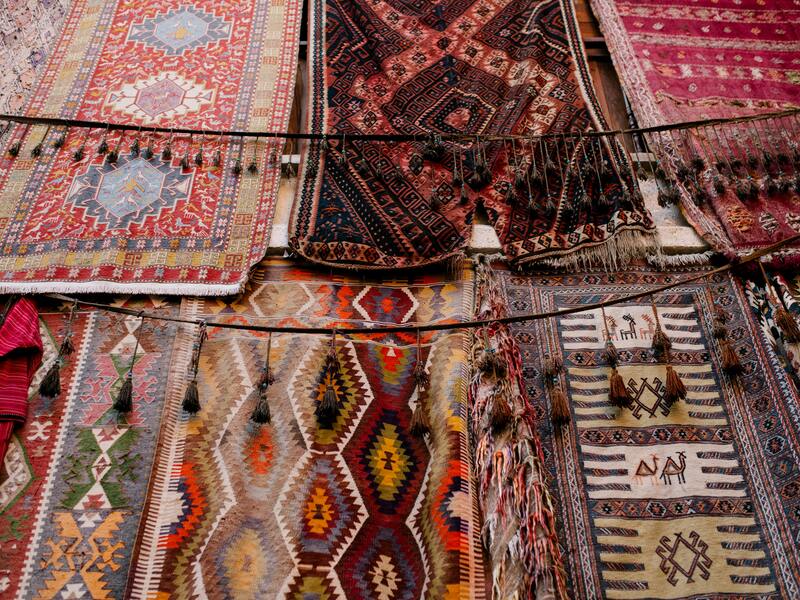
Turkish Carpet and Kilim Art
One of the most deeply rooted and aesthetic elements of Turkish culture, carpet and kilim art is far more than a simple floor covering—it is a bearer of historical identity and cultural narrative. This art form is directly linked to the nomadic lifestyle that Turks maintained for centuries. As nomadic communities, Turks lived in tent settlements and used carpets and kilims to make these temporary spaces warm, livable, and visually pleasing. In this context, the carpet gained both functional and symbolic value.
The Journey of the Carpet: Across Three Continents with the Turks
Wherever Turks traveled, they brought their carpets with them—a tradition that reached its peak during the Ottoman Empire. As Ottoman lands extended across Asia, Europe, and Africa, Turkish carpets became recognized and admired throughout these regions. A carpet was not merely a household item but a cultural emblem. In particular, carpets held symbolic meaning in Ottoman palaces. Due to security concerns, sultans did not allow their hands to be kissed; instead, the carpet representing the sultan’s presence was kissed. This practice clearly illustrates the carpet’s importance and prestige in palace culture.
Material and Technique: Elements That Define a Carpet’s Value
The value of a carpet is largely determined by the materials used and the knotting technique. Wool and cotton are the most common and economical materials. However, the most elegant and expensive examples of carpet weaving are made from silk. In recent years, bamboo fiber has also been introduced into carpet production, though this material does not appear in historical carpets and is considered a modern addition to traditional weaving.
The knotting technique plays a crucial role in the durability and aesthetic quality of a carpet. The Persian knot (also known as the Senneh knot) is easier to apply, while the Turkish knot—known as the Gördes knot—is more complex and results in a sturdier structure. Carpets woven with the Gördes knot are therefore considered superior in both quality and price.
Carpets in Art: Traces of Turkish Design in European Painting
Turkish carpets have found a place not only in Anatolia but also in European art. Prominent Renaissance painters such as Hans Holbein and Lorenzo Lotto featured Turkish carpets in their works, thereby introducing this cultural heritage to Europe through visual art. These carpets became known in the West as “Holbein Carpets,” showcasing the aesthetic power of Turkish weaving.
Carpet Weaving in Turkey: Regional Richness and Cultural Diversity
Today, traditional carpet weaving continues in many regions of Turkey. Cities such as Uşak, Kayseri, Cappadocia, Van, Antalya, Milas, and Bergama are important centers of Turkish carpet production, each with its own unique motifs and techniques. Among these, the most distinguished carpets are those woven exclusively for the Ottoman palace: the Hereke carpets. Known for their fine craftsmanship, elegant patterns, and high-quality materials, Hereke carpets represent the pinnacle of Turkish carpet art.
Modern Threats: Machine-Made Carpets and Cultural Erosion
In recent years, machine-made carpets—especially those manufactured in China—have begun to replace traditional handwoven ones. These products, often disguised as authentic woven carpets in tourist areas, diminish the value of cultural heritage and mislead consumers. Therefore, buyers should be cautious and prefer established stores or trusted cooperatives. A genuine Turkish carpet is not merely a decorative object—it is a historical narrative woven into fabric.
Last Modification : 10/12/2026 2:57:52 AM