Thanatos and Sisyphus
In Greek mythology, death is not merely an end but one of the fundamental pillars of cosmic order. The entity representing this order is Thanatos. A child of Nyx (Night) and the twin brother of Hypnos (Sleep), Thanatos is depicted as a winged deity tasked with carrying the souls of the dead to the realm of Hades. Yet, his role in mythology is largely confined to his struggle with Sisyphus, the cunning king of Corinth. This confrontation symbolizes humanity's defiance against the inevitability of death.
Thanatos: The Embodiment of Death
In mythological narratives, Thanatos is often portrayed as a cold and merciless figure. His presence marks the end of life, evoking fear among mortals. However, Thanatos is not merely an executioner—he is a force that maintains cosmic balance. Without death, life loses its meaning, and thus, Thanatos plays a crucial role in the functioning of the universe.
Resembling the Angel of Death in monotheistic religions, Thanatos does not inflict suffering when claiming souls; his duty is simply to facilitate the transition between life and death. Yet, when a cunning mortal like Sisyphus disrupts this duty, the divine order is shaken.
Sisyphus' Defiance
Sisyphus is one of Greek mythology's most deceitful and clever kings. Unafraid to expose the gods' secrets, he incurs the wrath of Zeus. To punish him, Zeus sends Thanatos with a clear mission: to take Sisyphus' soul and deliver him to the underworld.
But Sisyphus, foreseeing his fate, sets a trap. He tricks Thanatos and binds him in chains, stripping death of its power. With Thanatos imprisoned, death vanishes from the world. People no longer die—the wounded writhe in agony on battlefields, the elderly wither away, yet death does not claim them.
This chaos draws the attention of the gods. Zeus intervenes, sending Ares to free Thanatos. The god of war succeeds, and death is restored to the world. Though Sisyphus briefly escapes his fate, he is eventually captured and dragged to Hades to face his punishment.
The Punishment of Sisyphus: Eternal Toil
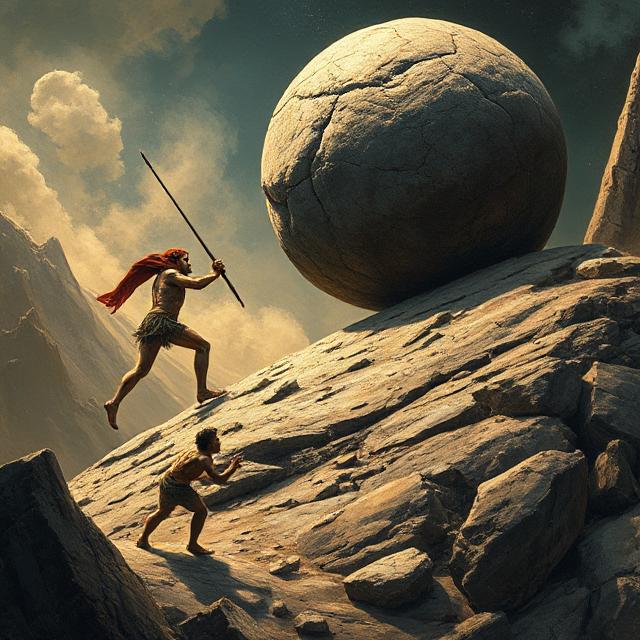
Sisyphus' punishment reflects his cunning. In the underworld, he is condemned to roll a massive boulder up a hill, only for it to roll back down each time he nears the top. He must repeat this futile labor for eternity. This torment serves as a metaphor for his attempt to escape death—just as he endlessly pushes the boulder, humans cannot evade their inevitable end.
Conclusion: The Inevitability of Death and Human Rebellion
The myth of Thanatos and Sisyphus symbolizes humanity's struggle against mortality. Sisyphus tries to outwit the gods in his quest for immortality, yet he ultimately fails. This story serves as a reminder of human limitations and the universal truth of death. Thanatos embodies this truth—inescapable, yet something we must confront.
Sisyphus' eternal toil represents the human search for meaning. Though it may seem absurd, this struggle is life itself. Even the brief moment when Thanatos was bound reflects humanity's desire for freedom and resistance. But in the end, death comes for all.
Last Modification : 9/1/2026 11:25:33 AM