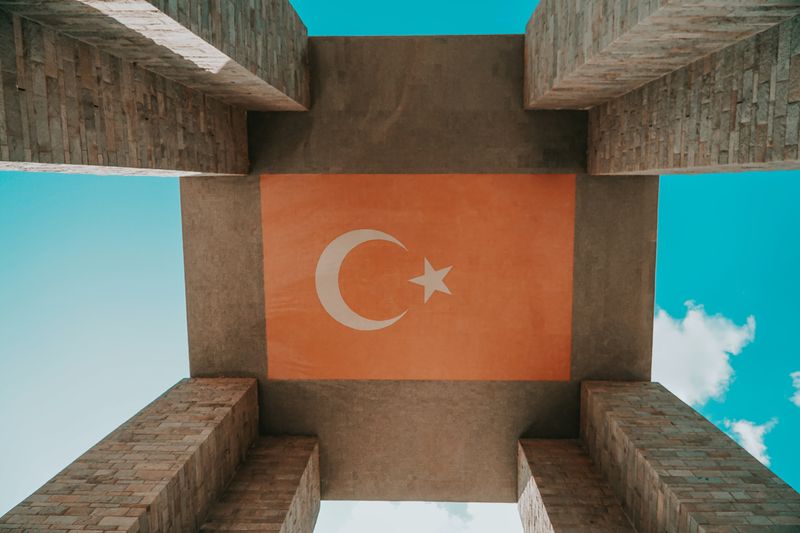
Gallipoli Martyrs' Memorial
Rising on Hisarlık Hill, overlooking Morto Bay at the southernmost tip of the Gallipoli Peninsula, the Çanakkale Martyrs' Memorial is not merely a monument; it is the shared memory of the Turkish nation's passion for independence, its solidarity, and the hundreds of thousands of heroes who gave their lives in defense of the homeland. Standing at an imposing 41.7 meters, this structure, which sends a historical message to everyone passing through the Dardanelles, is the product of a long and arduous struggle.
The Road to the Memorial
Following the Gallipoli Campaign, while numerous monuments and cemeteries were built on the Gallipoli Peninsula for the fallen British, French, Australian, and New Zealand soldiers, no national-scale memorial was erected for Turkish martyrs for many years, apart from a few modest structures. Yet the number of Turkish soldiers who lost their lives on these lands approached 213,000.
The first concrete step to address this deficiency came in 1943, when the Ministry of National Defense organized an architectural design competition. Among 37 proposals, the design by Feridun Kip, Doğan Erginbaş, and İsmail Utkular—students at Istanbul Technical University—was deemed worthy of first place. The jury described this project with the words: "This work is a masterpiece whose every stone shall remain unchanged." However, due to financial constraints, the project was shelved for a long time.
The Difficult Construction Process and National Mobilization
In 1952, upon the initiative of the National Turkish Student Union, the matter was brought to the agenda once again, and the "Committee for Assistance in the Construction of the Çanakkale Martyrs' Memorial" was established. The foundation of the memorial was laid on April 17, 1954, at Hisarlık Hill with a ceremony. However, the construction process was far from easy.
In 1955, upon the discovery that substandard materials had been used, construction was halted, and contracts with the contractors were terminated. Afterward, construction resumed, but this time it ground to a halt due to financial difficulties arising from economic hardships. The body of the memorial had reached only 12 meters in height.
At this critical juncture, the newspaper Milliyet launched a nationwide fundraising campaign on January 18, 1958. The newspaper's appeal was supported by other media outlets, and donations poured in from all segments of society in a short time. With the 1,686,000 Turkish Lira collected through the campaign, construction gained momentum once again.
Architectural and Spiritual Significance
The memorial is a massive reinforced concrete structure resting on four thick pillars. According to architect Doğan Erginbaş, it represents "the collective ascension toward the heavens of our martyrs who came from every corner of the geography." The four pillars symbolize the solid foundations and unbreakable will of the Turkish nation. When viewed from a distance, the monument's resemblance to the letter "M" associates it with Mehmetçik (the Turkish common soldier).
Of the eight reliefs located on the pillars of the monument, four depict naval battles, and the other four depict land battles. In the symbolic cemetery behind the memorial, 59,408 of our martyrs whose names could be identified are commemorated. This section, opened to visitors in 2007, offers an emotional journey to its visitors. The 45-meter-long giant relief, on the other hand, portrays scenes from the battles.
The Memorial Today and Its Significance
The Çanakkale Martyrs' Memorial was officially inaugurated on August 21, 1960, on the anniversary of the Second Battle of Anafartalar, in a ceremony attended by General Cevdet Sunay, then Chief of the General Staff.
Today, the memorial stands at the heart of commemorations for the Çanakkale Victory and March 18, Martyrs' Remembrance Day. Every year, thousands of people visit the memorial on these sacred lands to pray for their martyrs and to rekindle their love for the homeland with a historical consciousness.
The Martyrs' Memorial is not merely a place to remember the past, but also the most important stop for conveying the "Çanakkale spirit" to future generations. This spirit is the most powerful testament to what a nation can achieve through unity and solidarity. The story of the memorial is an unparalleled epic that demonstrates how a nation, even in times of scarcity, can create magnificent works and fulfill its debt of gratitude to its own heroes.
Last Modification : 8/31/2026 10:02:13 AM