Ephesus, the capital of the Roman Empire's province of Asia, was one of the most prominent cities in the Mediterranean world between the 1st and 3rd centuries AD. With a population of approximately 250,000, this port city was not only defined by its magnificent monuments but also by its rich daily life—from its streets to its houses, from its baths to its marketplaces—which served as a mirror of Roman civilization. Archaeological remains provide a surprisingly detailed picture of everyday life during this period.
The City's Pulse: Curetes Street and Public Spaces
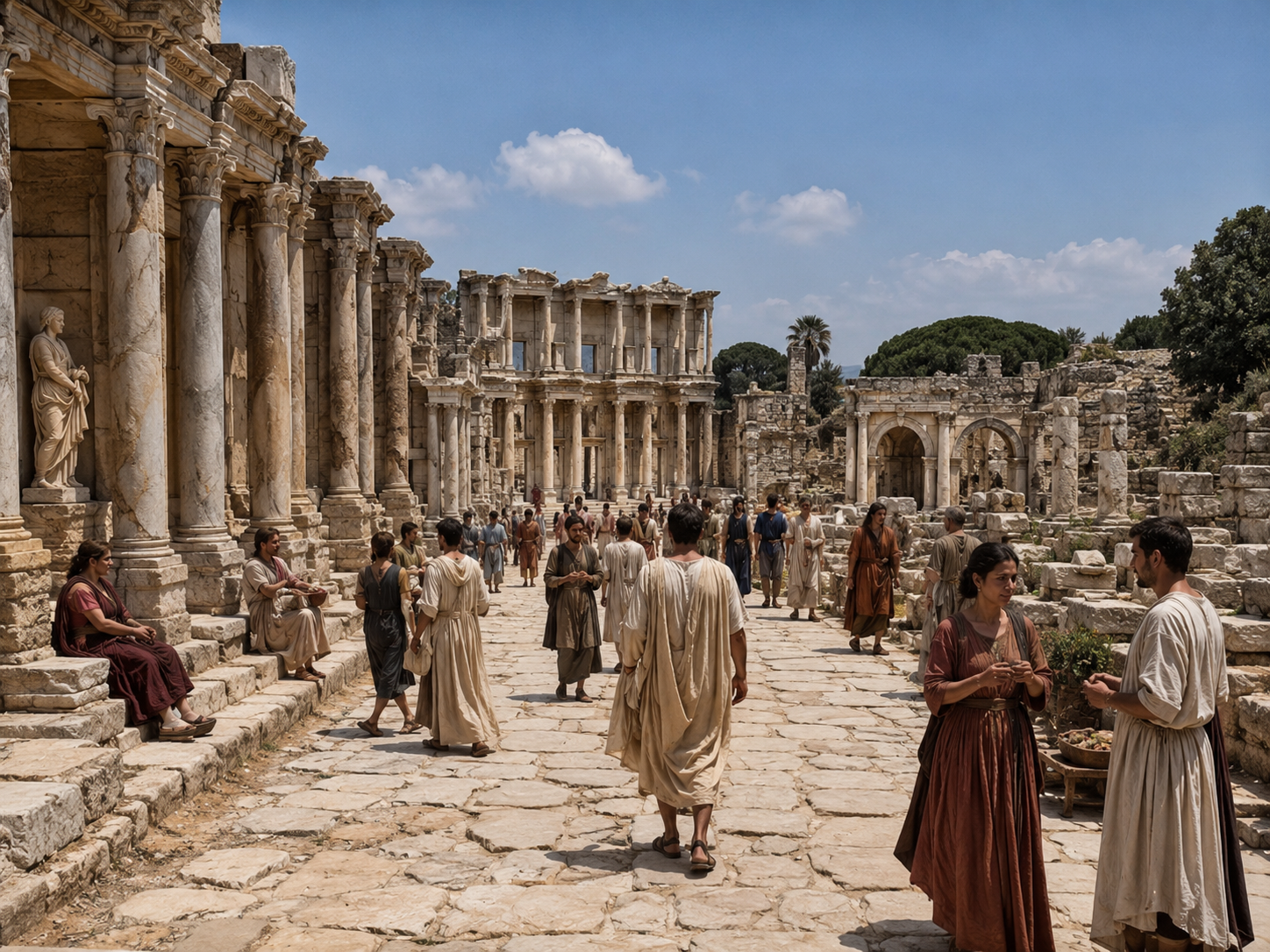
The heart of Ephesus was the magnificent Curetes Street, stretching from the Hercules Gate to the famous Celsus Library. This marble-paved street was the center of the city's social and commercial life. Lined with fountains, statues, monuments, and shops, it hosted the daily flow of Ephesians. The deep ruts left by carriage wheels on the pavement stones are testament to just how busy a thoroughfare it was. Wealthy Ephesians would walk along these streets in the morning to conduct business, meet with clients, and influence city politics.
One of the city's most impressive public structures was the massive Theater, capable of seating approximately 24,000 people. This was not only a venue for plays and performances but also a space for important assemblies and even riots. It was here that the crowd, incited by the silversmith Demetrius, gathered against the Apostle Paul's preachings.
The Neighborhood of the Rich: The Terrace Houses
One of the most exceptional glimpses into Ephesian daily life can be found in the Terrace Houses, a luxurious residential complex built on the hillside right in the center of the city. Constructed in the 1st century AD, this apartment block (insula) belonged to the city's elite. Comprising six units over three floors, this structure illuminates the private life of the Roman upper class. Unlike ordinary Roman dwellings, the Terrace Houses were equipped with underfloor heating systems, private baths, and sophisticated water installations.
The most striking feature of these houses was their extraordinary interior decoration. Rooms adorned with mosaics, frescoes, and marble paneling showcased their owners' wealth, cultural level, and intellectual ambitions. For instance, in House 2, a mosaic depicts Dionysus and Ariadne, while the walls of another room feature the Muses and philosophers. These luxurious apartments functioned less as simple residences and more as showrooms for the owners' social status. Hosting business meetings and client receptions in the morning and exclusive dinners for distinguished guests in the evenings, these spaces were the private reflection of Roman social life. Wealthy merchants and provincial governors, such as Caius Flavius Furius Aptus—the owner of House 6—used these homes to consolidate their power and influence.
Hygiene and Socialization: Roman Baths and Public Toilets
In Roman culture, cleanliness and socialization were intertwined. The bathhouses of Ephesus (such as the Scholastica Baths) were not merely places for washing; they were social hubs where people exercised, conversed, and debated literature and politics. As one of the first stops for visitors entering the city, the baths demonstrated Rome's advanced engineering and hygiene philosophy.
Connected to these bath complexes is one of the most intriguing structures: the Public Toilets, built in the 1st century AD. Though they seem unusual to modern visitors, with their 48 marble toilet seats lined up side by side, they were perfectly ordinary for the Romans. These toilets operated with a continuous water flow system beneath the seats and, in winter, were heated by the underfloor heating system piped in from the adjacent baths. This was also a social space; people would sit, chat, gossip, and even recite poetry. In an era before toilet paper, a sponge on a stick (tersorium) dipped in a bucket of vinegar water was used for cleaning. However, archaeological findings indicate that, despite this complex hygiene system, intestinal parasites were widespread among the populace—pointing to food contamination and inadequate hand hygiene.
Religion, Trade, and Entertainment
Religion played a central role in the daily life of Ephesus. The city's patron goddess Artemis (Diana to the Romans) was so significant that an entire month (Artemision) was considered sacred in her honor. It is estimated that nearly one million people attended the festivals held during this month. The Temple of Artemis, one of the Seven Wonders of the Ancient World, functioned not only as a place of worship but also as a major commercial bank and sanctuary. Craftsmen involved in trade often had to participate in the Artemis cult to sell their goods, demonstrating how deeply economic life was intertwined with religious rituals. The city also expected allegiance to the imperial cult, which posed major social and economic challenges for groups with monotheistic beliefs, such as Christians.
Trade was the lifeblood of Ephesus. Thanks to its harbor, the city sat at the crossroads of trade routes from the East and was a major stop on the Silk Road. However, this wealth was fragile. The constant silting of the harbor by alluvium carried by the Küçük Menderes River was the city's greatest ongoing problem. Although continuous dredging operations were financed by emperors and wealthy citizens, these efforts proved insufficient in the long run. The gradual filling of the harbor caused Ephesus to lose its commercial power and, consequently, its population, eventually leading to its abandonment. Today, the fact that Ephesus lies 12 kilometers inland is precisely due to this alluvial buildup.
Street-Level Advertisement: The Mysterious Stone of Curetes Street
One of the most unusual and intriguing pieces of evidence about daily life in Ephesus is a stone block located on the Marble Road leading from the Celsus Library toward the harbor. Widely known as the "world's first advertisement," this stone, dated to the 1st century AD, demonstrates just how early advertising and wayfinding systems developed in the ancient world.
The stone features four distinct relief carvings that set it apart from ordinary paving stones: a woman's head, a heart, a purse, and a left footprint. According to the most common archaeological interpretation, these symbols served as a directional advertisement for a nearby brothel:
- The woman's head and heart: Symbolize that beautiful women and love (or desire) were to be found here.
- The purse: Clearly indicates that payment was required for the service.
- The left footprint: Points the way—the establishment was located to the left from this point. Interestingly, some interpretations suggest that the size of the footprint also represented a minimum age requirement for entry—essentially, "you must have a foot at least this big" to enter.
Another fascinating aspect of this advertisement is its supposed connection to the nearby Celsus Library. According to popular tradition and some ancient sources, those who lacked the money or age for the brothel were effectively directed toward the library instead, offering them a more "intellectually enriching" experience. The existence of a secret underground tunnel connecting the two buildings—allowing Roman elites to discreetly pass from the library to the brothel—is also part of the legend.
However, it must be noted that this interpretation is not definitive. Some researchers argue that the woman's crown suggests she is the Mother Goddess Cybele or the city's patron deity Tyche, implying the symbols may carry a different religious or commercial meaning. Furthermore, recent excavations in the area indicated by the stone have revealed the remains of three ordinary houses rather than a brothel, keeping the debate about the stone's true purpose alive. Regardless of its exact function, this stone stands as tangible evidence that 2,000 years ago, the streets of Ephesus contained directed messages meant to guide and inform passersby—highlighting just how layered, complex, and colorful urban life was during the Roman period.
Roman Ephesus was a city where grandeur and everyday challenges, public spectacle and private life, advanced engineering and social problems all coexisted. From the sophisticated lifestyle in the Terrace Houses to the unusual socializing at the public toilets, from the exuberance of the Artemis festivals to the desperate efforts to save the harbor—and even to the advertisement stones on its streets—the daily life of Ephesus reveals both the allure and the fragility of living in a metropolis during the height of the Roman Empire.