The Temple of Artemis
: One of the Seven Wonders of the World
The Seven Wonders of the World is a legendary list defining the most fascinating structures of the ancient world. While most of the works on this list survive only in the dusty pages of history and the remains unearthed in excavations, each one is a unique symbol of humanity's passion for creativity, faith, and grandeur. One of these symbols is the Temple of Artemis, the magnificent religious center of the ancient world.
1. Artemis and the Meaning of the Temple
Artemis is the Greek goddess of hunting, nature, wild animals, and chastity. Her Roman counterpart is Diana. However, the Artemis worshipped at Ephesus (Artemis Ephesia) was different from the traditional Greek depiction. Represented by statues with multiple breasts, this Artemis was a goddess of fertility and abundance, blended with the mother goddess cults of Anatolia. Therefore, the temple was not just a sacred pilgrimage center for a single Greek polis, but for all of Anatolia and even the entire Mediterranean world. The location where the temple was built, Ephesus (near the modern town of Selçuk in İzmir), was a wealthy and cosmopolitan port city at the crossroads of trade routes at the time. It was only natural that the temple dedicated to the city's patron goddess, Artemis, would be the most magnificent in the world. For the Ephesians, Artemis was not merely a goddess but also the protector of the city and its people. One of the most striking examples of the strength of this belief occurred during a war. According to ancient sources, when the Ephesians found themselves helpless against an enemy attack, they tied a long rope to the Temple of Artemis and held onto it, physically binding themselves to the goddess. This act was not merely symbolic devotion but an expression of their absolute faith that "Artemis will protect us." The Ephesians holding the rope firmly believed that the goddess would protect them in battle and that the city would not be surrendered to the enemy. This event is the most vivid evidence that Artemis was seen not only as an object of worship in Ephesus but also as a military ally and the guardian of the city.
2. A Masterpiece of Architecture: The Second Temple
The first known Temple of Artemis was built in the 7th century BC, but was set on fire by an arsonist named Herostratus in 356 BC. This man was a megalomaniac spirit who wanted to etch his name into history "for achieving something." Ironically, it is said that Alexander the Great was born on the night the temple burned. Plutarch comments on this situation: "The goddess Artemis was too busy helping Alexander be born to protect her own temple." Following the fire, Alexander the Great conquered Ephesus and offered financial aid for the reconstruction of the burnt temple. However, the Ephesians refused this offer, giving one of the most remarkable diplomatic answers of the ancient world. According to them, "It was unacceptable for one god to help another god or goddess." Alexander the Great presented himself as the son of Zeus and claimed divine status. Even if the Ephesians accepted this claim, they argued that it would be theologically inappropriate for a god (Alexander) to build a temple for a goddess (Artemis). This response demonstrates how tightly the Ephesians clung to their religious beliefs and that not even emperors could change the rules of these beliefs. Refusing Alexander's aid, the Ephesians decided to rebuild the temple themselves, with even greater splendor. This Second Temple would come to be known as one of the Seven Wonders of the Ancient World.
- Architects: Chersiphron of Knossos and his son Metagenes (the construction was later completed by Daphnis and Paeonius).
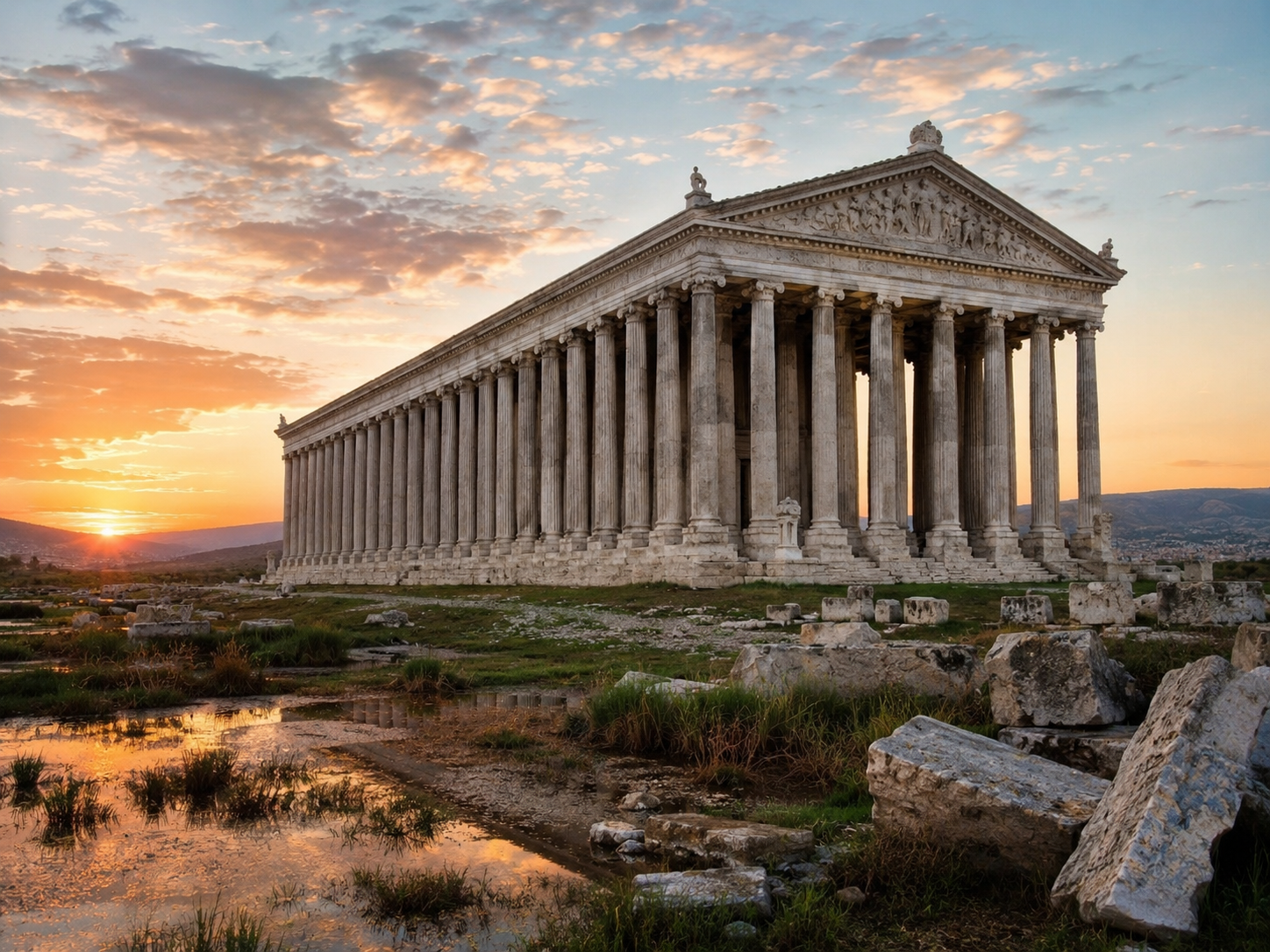
- Dimensions: Approximately 115 meters long and 55 meters wide. These dimensions made it even larger than the Parthenon in Athens.
- Columns: A total of 127 columns, each approximately 18 meters high. Some of these columns were fluted, while others were decorated with reliefs. The lower parts of 36 columns were adorned with rich figurative reliefs.
- Material: The temple was built entirely of white marble. This was an extraordinary engineering achievement for a colossal marble structure at that time.
- Sculptures: Inside the temple stood Artemis's famous "many-breasted" cult statue. Additionally, works by renowned sculptors (such as Praxiteles and Scopas) adorned the temple. The temple functioned not only as a place of worship but also as a massive sanctuary (asylum), a bank, and an art gallery. Even during inter-city wars, those who took refuge in the temple were considered inviolable.
3. Destruction and Oblivion
The magnificence of the Temple of Artemis continued throughout the Roman Empire period. However, with the rise of Christianity and its establishment as the official religion of the empire, pagan temples became targets. In 401 AD, at the instigation of Bishop Saint John Chrysostom, a Christian mob razed the temple to the ground. Its stones were used to build new churches. For centuries, the temple was completely forgotten, buried under the alluvium brought by the Cayster River (Küçük Menderes). Its existence became a legend found only in ancient texts.
4. The Silent Witness of Pagan Resistance: The Extraordinary Findspot of the Artemis Statue
Archaeological excavations show that historiography is sometimes rewritten through the silent language of stones and objects. Contrary to expectations, the goddess's famous cult statue was not found among the ruins of the Temple of Artemis. Instead, the statue was unearthed in a much more meaningful and surprising location: the Prytaneion, the official and administrative center of the ancient city of Ephesus (The Prytaneion was the place where the city's sacred hearth and chief priest were located, and where state ceremonies were held). This situation, though surprising at first glance, actually points to a very profound historical truth. When the temple was officially destroyed in 401 AD, one would have expected the cult statue of Artemis, the tangible symbol of pagan belief, to be destroyed or buried with the temple. However, the fact that the statue was found not at the temple site but in the Prytaneion, the city's most important administrative building, is one of the most striking archaeological proofs that the public did not easily give up their pagan faith despite the official acceptance of Christianity. This discovery means the following: Even after the temple was destroyed, a group of Ephesians rescued their sacred statue, carried it to the Prytaneion, one of the city's most prestigious public buildings, and continued the cult there. The fact that the statue was preserved in this symbolic place, where the city's official hearth was located, shows that the cult of Artemis continued not only among the common people but also within the city's ruling class. This act proves that even when the empire's official religion changed, the cult of Artemis continued to exist for years, perhaps centuries, in daily life, private spheres, and even some official circles. The statue, in a sense, became a symbol of silent but determined resistance against Christianity.
5. Rediscovery and Today
The remains of the temple were found in 1869 by the English archaeologist John Turtle Wood after seven years of challenging excavations. Today, near the ancient city of Ephesus, what remains of the temple is quite modest: a single re-erected column (with fragments of other columns scattered around), some foundation walls, and marble blocks. The original statue of Artemis found in the Prytaneion is now exhibited among the most precious artifacts of the Ephesus Museum in Selçuk. When visitors look at this statue, they see not just a mythological figure, but also the tangible witness of a faith that resisted destruction, carrying its roots for thousands of years beneath the soil. However, not all of the temple's treasures remained within the borders of Turkey. Many artifacts unearthed during Wood's excavations were sent to the British Museum in England under the permissions of the period. Among these artifacts in London today are important pieces that reveal the temple's grandeur:
- Marble Column Drum (Column Fragment): This relief-adorned column drum from the Later Temple features mythological scenes (figures such as Thanatos (Death), Hermes (Messenger of the Gods), and Plouton (God of the Underworld)). Dated to the Hellenistic period, this artifact is displayed in Room 22 of the British Museum ("The World of Alexander the Great").
- Artemis Statuettes: Small terracotta statuettes found in the temple area, bearing the "many-breasted" iconography of Artemis Ephesia, are in the British Museum collection.
- Inscribed Altar (Stele): A marble altar fragment with Greek inscriptions honoring Ephesian priests (neopoioi) is also preserved in the museum. These inscriptions provide important information about the temple's functioning and Ephesian society.
- Numerous Small Finds: Many small artifacts found at the temple site, such as beads, lamps, architectural fragments (like Ionic column capitals), and items related to daily life, are also in the British Museum's storage and on display. This situation shows that the heritage of the Temple of Artemis is now divided between two major museums: the original statue from Ephesus is in Turkey, while the relief-adorned column drum and many other artifacts are in London. This dispersion is part of the complex legacy of 19th-century archaeology and the debate over the removal of artifacts from their original lands.
The Temple of Artemis was a center that beat at the heart of the ancient world, not only with its size but also with its synthesis of a belief system, art, and architectural genius. The Ephesians' act of tying a rope to the temple in war to seek the goddess's protection, and their refusal of Alexander the Great's offer of aid by saying "a god cannot help a goddess," shows how deep, conscious, and uncompromising this belief was. Despite Herostratus's vanity, fires, and deliberate destructions, this faith lived on. But what is truly fascinating is the story after the temple's destruction: The discovery of the statue in the Prytaneion is the strongest archaeological proof that beliefs cannot be changed by state decree and of people's profound attachment to the sacred. Today, when we look at the single column standing on the site, the original statue in the Selçuk Ephesus Museum, and the relief-adorned column drum and other artifacts displayed in the British Museum in London, we see not only that "the world's greatest wonder" once existed here, but also how that wonder continued to live on in the human heart.
Last Modification : 9/21/2026 6:45:36 PM