The Best 2-Hour Itinerary for Ephesus
Ephesus Ancient City is one of the best-preserved ancient cities in the world, welcoming millions of visitors each year. As the capital of the Roman Empire in Anatolia, this magnificent city is listed as a UNESCO World Heritage Site. If you have limited time and want to explore Ephesus in just 2 hours, following the right route will allow you to see the most important landmarks of the ancient city. Here is the ideal route for you to explore Ephesus in 2 hours.
🏛️ Starting the Route: Entering from the Upper Gate
To use your time efficiently and avoid exhaustion, make sure to enter through the Upper Gate (Magnesia Gate) . Starting from here, you will walk downhill along the main street. This way, you will conserve your energy while discovering the magnificence of the ancient city step by step.
⏳ 2-Hour Time Schedule
First 30 Minutes: State Agora and Odeon
After entering through the Upper Gate, you will encounter the State Agora, the political and administrative heart of the ancient city. This was the main square of Ephesus where official business and public meetings were held, rather than trade. The Agora served as the administrative center of the city during the Roman period and was surrounded by colonnaded galleries.
Right next to the State Agora is the Odeon (Small Theatre) , built around 150 AD. With a capacity of approximately 1,500 people, this structure served two different purposes: it hosted meetings of the city senate (as a Bouleuterion) on one hand, and cultural events such as concerts and poetry recitals (as an Odeum) on the other. Take a few minutes to experience the Odeon's excellent acoustics; you will notice that someone speaking on the stage can be heard clearly even from the top rows.
30-45 Minutes: Nike Relief and Domitian Square
After visiting the Odeon and State Agora, your next stop is Domitian Square. This square was one of the most important public spaces in Ephesus and took its name from the Roman Emperor Domitian. Featuring monumental structures, fountains, and statues dedicated to Emperor Domitian, this square was considered one of the political and religious centers of the ancient city. Excavations conducted in 2022 revealed that the square was also used as a commercial and dining area during the early Byzantine period.
The most remarkable detail that will catch your attention in Domitian Square is the Nike Relief, which appears as a relief on the ground. The Goddess of Victory Nike is depicted as a winged figure holding a laurel wreath and a palm branch. This relief is known as the inspiration for the iconic "swoosh" logo of a world-famous sports brand today. It's a great spot for photos—but don't forget that the relief is on the ground!
45-75 Minutes: Curetes Street and Terrace Houses
After leaving Domitian Square, step onto the Curetes Street, the main axis of the ancient period. As you walk along the street flanked by columns and building ruins on both sides, you can imagine the daily life of the Roman era. Must-see stops in this section include:
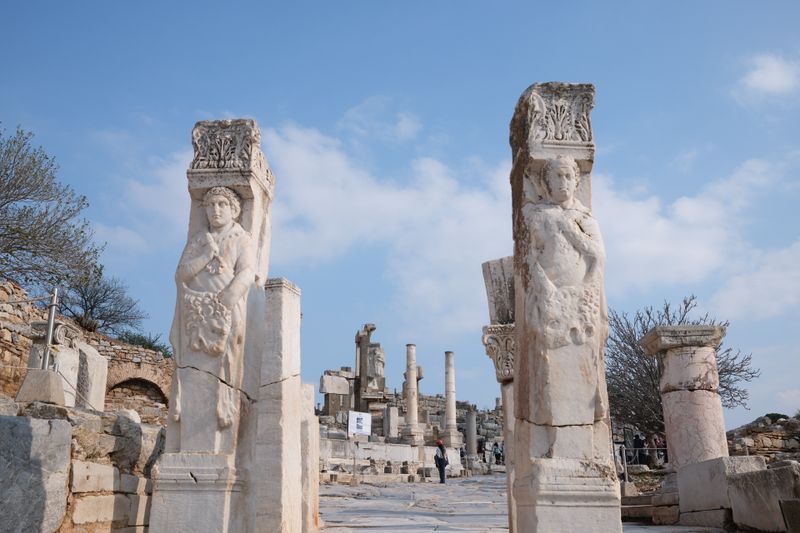
- Hercules Gate: This narrow gate at the entrance of the street is notable for its reliefs.
- Trajan Fountain: One of the fine examples of ancient water architecture.
- Hadrian's Temple: With its well-preserved architecture and the arch featuring Medusa reliefs, it is one of Ephesus' most photogenic structures.
The Terrace Houses located on Curetes Street are filled with mosaics and frescoes that showcase the luxurious lifestyle of Ephesus' wealthy residents. This section requires a separate ticket, but allocating time to visit it during your 2-hour itinerary will greatly enrich your ancient city experience. If you choose to visit the Terrace Houses, you should allocate approximately 25-30 minutes for this section.
75-90 Minutes: Library of Celsus
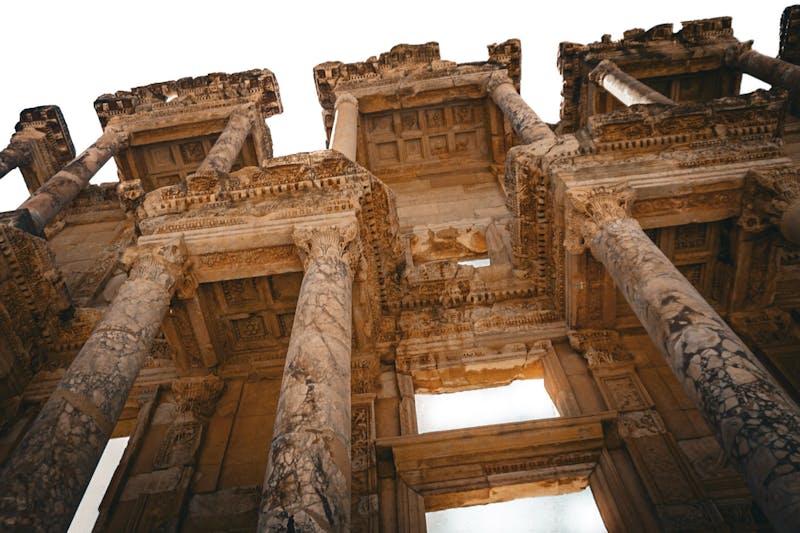
At the end of Curetes Street, the most iconic structure of Ephesus, the Library of Celsus, will greet you. With its magnificent two-story facade and statues, this structure was the third largest library in the ancient world after Alexandria and Pergamon, and stands as one of the finest examples of Roman architecture. The library was built in 117 AD by Roman Consul Gaius Julius Aquila in memory of his father Celsus. The four female statues on its facade represent Wisdom, Virtue, Intellect, and Knowledge. Be sure to take photos. Take time to photograph the library from the front, at a symmetrical angle.
90-105 Minutes: Marble Street and the Great Theatre
After leaving the Library of Celsus, continue walking along the Marble Street, which will lead you to the Great Theatre. This street was one of the busiest roads of the ancient period and was where commerce thrived.
At the end of the road, the Great Theatre will appear before you. With a capacity of 25,000 people, this is one of the largest theatres of the ancient world, hosting both gladiatorial fights and public gatherings. Don't forget to enjoy the view of the Aegean Sea from the upper steps of the theatre. Additionally, it is known that the Apostle Paul preached here and the crowd attempted to lynch him, highlighting the theatre's importance in Christian history.
Final 15 Minutes: Harbour Street and Exit
After the Great Theatre, follow the Harbour Street (Arcadiane Street) , which extends to the ancient city's harbor, and head toward the Lower Gate. This street was the main axis of the city during the Roman period, lined with columns on both sides. You can complete your 2-hour tour of Ephesus by exiting through the Lower Gate.
💡 Golden Tips for a 2-Hour Tour
- Start Early: To avoid extreme heat and crowds during the summer months, begin your visit when the ancient city opens at 08:00 in the morning.
- Wear Comfortable Shoes: The paths in the ancient city are rocky and uneven. Prefer comfortable and sturdy shoes.
- Don't Forget Water and a Hat: There is very little shaded area; consume plenty of water, especially in summer, and protect yourself from the sun.
- Make Time for the Terrace Houses: If you have 2 hours, be sure to allocate time for the Terrace Houses. This is where you can best see the luxurious life of ancient Rome.
🏛️ Visitor Information
- Opening Hours: Open for visits between 08:00 – 19:30 in summer, and 08:30 – 17:30 in winter.
- Entry Fee: Separate ticket fees apply for the ancient city entrance and the Terrace Houses.
By following this route, you can discover the most important structures of Ephesus Ancient City in 2 hours and take a short yet unforgettable journey into the magnificent past of the Roman Empire. Enjoy your trip! 🏛️
Last Modification : 8/31/2026 10:06:42 AM