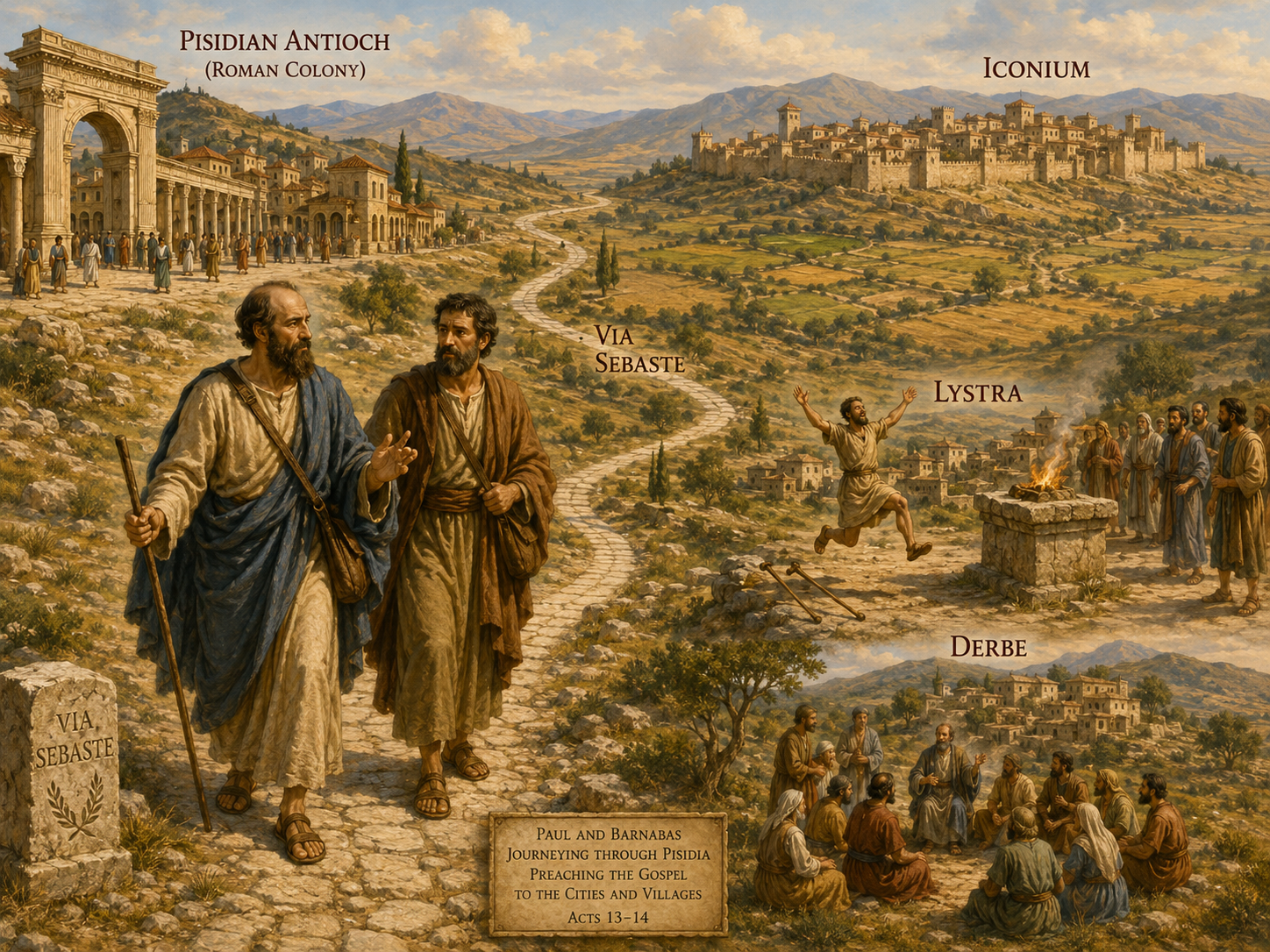
St. Paul’s Missionary Journeys Through Anatolia
Anatolia (modern-day Turkey) served as the crucial bridge between the Eastern and Western worlds during the Roman Empire. For St. Paul the Apostle, this region was not merely a passage but the very stage upon which the early Christian mission unfolded. Among the many cities Paul visited, four stand out for their theological and historical significance: Antioch (Pisidian Antioch), Iconium (Konya), Lystra, and Derbe. These cities, located in the Roman province of Galatia, formed a circuit that would become the backbone of Paul’s first major missionary journey (Acts 13–14) and a recurring focus of his ministry.
Antioch in Pisidia: The Launchpad of Gentile Mission
Not to be confused with the Syrian Antioch (where believers were first called Christians), Pisidian Antioch was a Roman colony—a “little Rome” carved into the mountainous highlands. Its strategic location on the Via Sebaste, a major military road, made it a hub of Roman culture, law, and religion.
Paul and Barnabas entered the synagogue in Antioch on the Sabbath. Paul’s sermon (Acts 13:16–41) is the first fully recorded apostolic discourse to a mixed audience of Jews and God-fearing Gentiles. When many Gentiles believed, jealous Jewish leaders incited persecution, forcing Paul and Barnabas to leave. Yet Antioch became a template: the gospel offered first to Jews, then to Gentiles; rejection by some leads to the joy of many others.
Theologically, Pisidian Antioch marks Paul’s decisive turn toward the Gentile world. His famous declaration, “We now turn to the Gentiles” (Acts 13:46), was spoken here.
Iconium: Faith Amid Division
Moving southeast along the Via Sebaste, Paul arrived in Iconium, a Phrygian city known for its fertile plains and mixed population of Jews, native Phrygians, and Roman settlers. Iconium’s soil was not only agricultural but spiritual: the gospel took root deeply, but the weeds of opposition grew just as fast.
Luke records that in Iconium, Paul and Barnabas stayed “for a considerable time, speaking boldly for the Lord” (Acts 14:3). Signs and wonders confirmed their message. Yet the city split into two factions—one siding with the apostles, the other with hostile Jewish and Gentile leaders. A planned stoning forced them to flee to Lystra.
Iconium teaches us that Christian mission does not produce consensus but division—a sign, in Luke’s view, of the inbreaking of God’s kingdom. Later, Paul would return to Iconium (Acts 16:2), finding a mature church led by figures like Timothy’s mother Eunice, a native of the region.
Lystra: From Pagan Worship to Near-Death
Lystra was a smaller, less Romanized town. Its population spoke mainly Lycaonian, a local dialect, and retained strong pagan traditions. When Paul healed a man crippled from birth, the crowd’s reaction was startling: they mistook Paul and Barnabas for Hermes and Zeus incarnate. A priest from the temple of Zeus outside the city brought oxen and garlands to sacrifice to them (Acts 14:8–18).
Paul’s response—“We too are only human, like you”—is one of the earliest recorded attempts to articulate natural theology and critique pagan religion in a rural Anatolian setting. But the crowd’s devotion turned to violence when Jews from Antioch and Iconium arrived. They stoned Paul and dragged him outside the city, believing him dead. Miraculously, he rose and re-entered Lystra the next day.
Lystra thus became a symbol of resurrection power: not just the healing of a lame man, but the apostle’s own survival of a death sentence. The young Timothy, a native of Lystra (Acts 16:1–3), would later become Paul’s most trusted companion—a living fruit of that dangerous, glorious visit.
Derbe: The Quiet Triumph
Unlike Lystra and Iconium, Derbe presented no violent opposition. Luke records simply that Paul and Barnabas “preached the gospel in that city and won a large number of disciples” (Acts 14:21). Derbe was the easternmost point of the first journey, a frontier town on the border between Galatia and Lycaonia.
Derbe’s significance is often overlooked because of its lack of drama. Yet it offers a vital missiological lesson: not every encounter ends in rejection or persecution. Derbe represents the patient, joyful growth of the church in places receptive to the Word. Later, one of Paul’s companions, Gaius of Derbe (Acts 20:4), would accompany Paul on the third journey—showing how this quiet city produced enduring leadership for the wider church.
Returning through Lystra, Iconium, and Pisidian Antioch, Paul and Barnabas strengthened the disciples, appointed elders, and entrusted each church “to the Lord, in whom they had believed” (Acts 14:23). These four Anatolian cities, though different in culture and reception, shared a common destiny: they became cells of a new spiritual movement that would eventually reshape the Roman world.
For Paul, Anatolia was not simply geography. It was a theological laboratory where the gospel crossed ethnic boundaries (Jew and Gentile), social hierarchies (Roman colonists and native peasants), and religious worldviews (pagan worship and synagogue piety). The journey through Antioch, Iconium, Lystra, and Derbe is a story of rejection and embrace, stoning and healing, fear and boldness—proving that in the weakness of the apostle, the power of Christ was made perfect.
Last Modification : 8/31/2026 10:06:58 AM