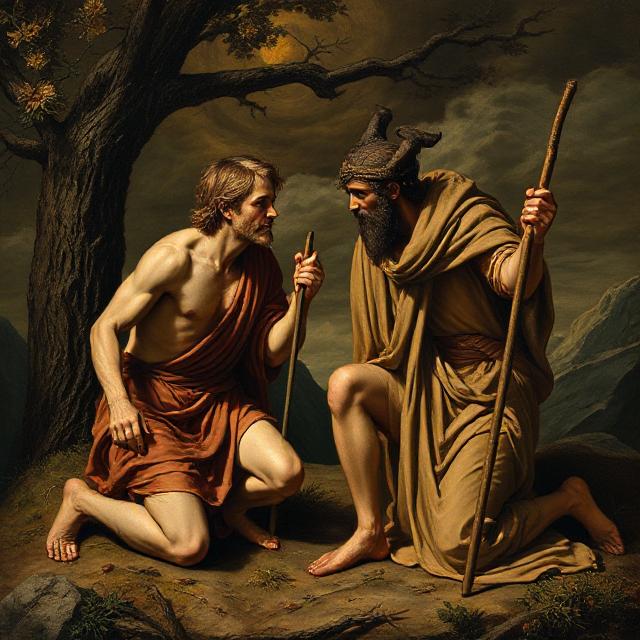
The First Fracture of Humanity
One of the oldest narratives in human history is the story of Cain and Abel, the sons of Adam and Eve. This tale is not merely a sibling rivalry—it is a profound reflection on jealousy, the search for justice, and humanity’s relationship with the divine. It also opens a timeless space for contemplating the sanctity of the earth, the meaning of sacrifice, and the nature of guilt.
The story appears in the Torah, the Qur’an, and other sacred texts in varying forms. At its core, it is an allegory of inner conflict and spiritual positioning. Cain and Abel are not just two brothers—they are archetypes of two human conditions: one bound to the soil, the other to the flock; one consumed by envy, the other offering in surrender.
The Birth of Cain and Abel: Children of Soil and Herd
Adam knew Eve, and she conceived. She gave birth to Cain, followed by Abel. Cain became a farmer, tilling the land; Abel a shepherd, tending his flocks. This distinction is more than occupational—it is symbolic. Cain represents settled life and production; Abel, nomadic existence and closeness to nature.
This duality echoes through Anatolia’s historical layers. For centuries, cultural tensions existed between the agricultural communities of the Aegean plains and the pastoral tribes of the Taurus foothills. In this sense, Cain and Abel are not merely individuals but cultural archetypes.
Sacrifice and Acceptance: Divine Preference
In time, both brothers offered sacrifices to God. Cain brought produce from the land; Abel offered the firstborn of his flock and their fat portions. God accepted Abel’s offering but turned away from Cain’s. This rejection ignited a fire of jealousy and rage in Cain’s heart.
Here, the nature of the sacrifice is crucial. Abel gives the best; Cain, the ordinary. God’s choice is not based solely on material value but on the depth of intention. In Anatolia, sacrificial rituals—especially those offered to Artemis in ancient Ephesus—echo this narrative. Sacrifice is not just a gift, but a form of surrender and purification.
The Murder: The First Blood Spilled by a Brother
Cain succumbs to his anger. He calls his brother to the fields, speaks with him, and suddenly attacks and kills him. Thus, the first murder in human history is committed—blood spilled by a brother’s hand. This blood wounds not only a body but the conscience of humanity.
God speaks to Cain: “Your brother’s blood cries out to me from the ground.” This statement reveals that the crime is not merely personal—it reverberates cosmically. The earth will no longer yield its fruit to Cain; he will wander the world as a fugitive and a vagabond. The brother-killer is cast out from every place.
Curse and Mercy: The Dual Face of the Divine
Cain repents. He pleads with God:
“My guilt is too heavy to bear. You have driven me away, and I will hide from you. I will be a fugitive on the earth, and whoever finds me will want to kill me.”
God shows mercy. He places a mark upon Cain—so that no one will kill him. This mark becomes both a protection and a symbol of shame. Cain will live a cursed life, but he remains under divine justice.
The nature of this mark is unknown. Yet across cultures, it has been interpreted in many ways: a stigma, a sign, a warning. In Anatolian folklore, the “marked” are often seen as both outcast and sacred. Cain’s mark, in this sense, is both punishment and reminder.
Cultural and Mythological Echoes
The story of Cain and Abel resonates not only in sacred texts but also in folk literature, poetry, and mythology. In Anatolia, themes of brotherhood and jealousy are deeply woven into epic tales and laments. This narrative intertwines with the cult of Artemis in Ephesus, the healing rituals of Asklepion in Pergamon, and the stories etched into the stones of Istanbul.
Cain’s curse is not only personal—it is a societal warning. Brotherhood is the most fundamental human bond; its rupture signals the unraveling of community. Abel’s death marks the loss of innocence; Cain’s exile, the burden of conscience.
After the First Murder
The story of Cain and Abel is the first fracture in human history. And that fracture remains unhealed. With every act of envy, every injustice, every sibling conflict, this tale is reborn. The earth still absorbs blood, and God still asks: “Where is your brother?”
The answer to this question is not only personal—it is a cultural and moral responsibility. Cain’s mark is still upon us. To recognize it, understand it, and transcend it is one of humanity’s oldest tasks.