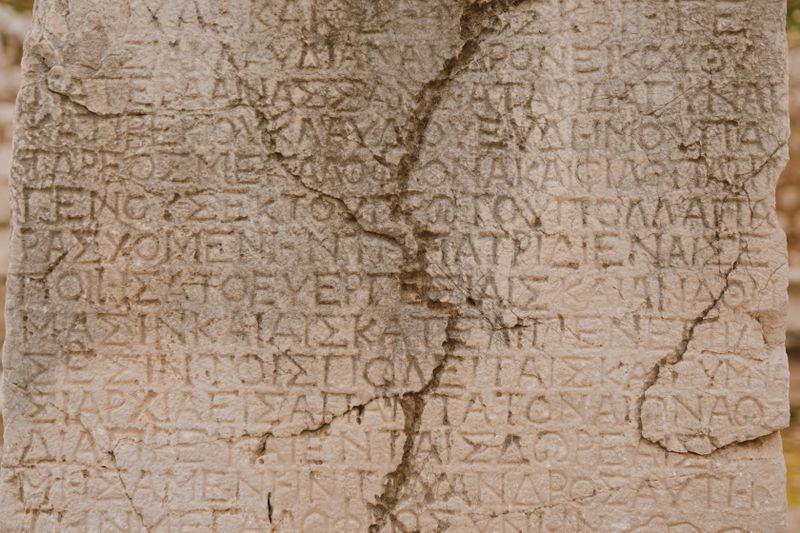
The transition from prehistory to the historical age is one of humanity's most important turning points. The greatest invention enabling this transition is undoubtedly writing. The invention of writing not only allowed for the recording of information but also fundamentally transformed all the core dynamics of civilization, from state order and law to trade, literature, science, and philosophy. This article will examine why and how writing emerged, its earliest examples, and its revolutionary impact on human history.
The Birth of Writing: Needs and Solutions
The invention of writing was not a sudden stroke of inspiration but rather the product of a long evolution driven by increasing human needs. With the Neolithic Revolution, as humans settled into sedentary life, they began farming, domesticating animals, and storing surplus produce. This brought about a complex economic and social structure. The concepts of increasing produce and ownership created a need for record-keeping. How much grain was stored? Which family owned which animals? Who owed what to whom? These questions required a solution beyond human memory.
The first step was the use of tokens (clay symbols) in Mesopotamia, around 8000-6000 BCE. These small clay objects in various shapes represented commodities like sheep, grain, or oil. Over time, these tokens were placed inside hollow clay spheres called bullae. However, seeing the contents of a bulla required breaking it. The search for a more practical method led to the impression of the token symbols onto the outer surface of the bulla. Thus, three-dimensional tokens transformed into two-dimensional symbols. Over time, these symbols became more abstract and standardized, forming the basis of the first writing systems.
The First Writing Systems: From Cuneiform to Hieroglyphs
According to most historians, true writing first emerged around 3400-3200 BCE in Mesopotamia, invented by the Sumerians. This first system was proto-cuneiform, which later evolved into cuneiform script. Sumerians used reed styli to press wedge-shaped marks into soft clay tablets. Initially pictographic, these marks were gradually stylized for faster writing and evolved to represent syllables (logographic and phonetic). This made it possible to express not only objects but also abstract concepts, verbs, and personal names.
In Egypt, around the same period, hieroglyphic writing developed. Hieroglyphs emerged independently from Sumerian cuneiform and were primarily used on stone, monuments, temple walls, and papyrus. This system, using both pictorial (ideograms) and sound-based (phonograms) signs, was mainly preferred for sacred and official texts such as religious documents, royal decrees, and the Book of the Dead.
After Mesopotamia and Egypt, writing was invented independently in several other centers, including the Indus Valley (Indus script), Crete (Linear A and B), China (Shang dynasty oracle bone script), and Central America (Olmec and Maya hieroglyphs).
The Impact of Writing on Civilization: A Paradigm Shift
The invention of writing was a multi-dimensional revolution that changed the course of history. The most fundamental consequence of this revolution is the radical transformation in how we access knowledge.
1. Achieving Certainty in Archaeology and Historical Science:
In archaeological excavations from the period before the invention of writing, archaeologists can only make conjectures based on material remains (pottery, tools, wall foundations, burial practices). Why a settlement was abandoned, whether the relationship between two cultures was war or trade, whether a structure was a temple or a warehouse – these are largely matters of interpretation and assumption. However, with the invention of writing, archaeologists and historians were freed from having to rely on guesswork and gained the ability to access certain knowledge directly. A king's decree, an account of a battle, a tax record, or a court verdict written on a clay tablet documents the abstract thought, legal system, and social relations of that period firsthand, grounding archaeological interpretations in evidence. For this reason, writing is the most important tool that allowed history to gain certainty as a science.
2. The Beginning of History:
Thanks to written documents, events could be passed down from generation to generation, and an objective record of the past could be kept. Therefore, the period before the invention of writing is called Prehistory, and the period after is called the Historical Age. The past became a documentable reality, free from myths and oral traditions.
3. State and Law:
Centralized state administrations became dependent on writing for tax collection, censuses, proclamation of laws (e.g., the Code of Hammurabi), and the administration of the army. Writing limited arbitrary rule by making laws binding and permanent for everyone.
4. Economy and Trade:
Long-distance trade found a secure foundation through contracts, receipts, promissory notes, and accounting records. Writing standardized economic transactions and increased their reliability.
5. Science and Philosophy:
Because accumulated knowledge was recorded in writing, each generation could build upon the findings of previous ones. Systematic thought in mathematics, astronomy, medicine, and philosophy only became possible with writing. Once thoughts were put on paper, they became open to criticism, development, and dissemination.
6. Literature and Culture:
Narratives that lived in oral tradition, such as the Epic of Gilgamesh, the Iliad, and the Odyssey, were immortalized through writing. A vast cultural heritage, from mythology to history, poetry to religion, was preserved.
Following complex systems like cuneiform and hieroglyphs, around 1050 BCE, the Phoenicians developed a 22-sign alphabet consisting only of consonants. This system was perfected by the Greeks, who added vowels, forming the basis of the modern Latin, Cyrillic, and Greek alphabets. The alphabet made writing learnable and usable for everyone, leading to the spread of literacy.
Today, in the digital age, we are transforming writing through keyboards and screens, but the core functions of writing – storing and transmitting information, making thought permanent, and freeing human history from conjecture by providing certain knowledge – remain unchanged. The invention of writing is a tool that built humanity's collective memory and defied time. Without this great leap, it would be impossible to speak of science, law, history, and civilization as we know them today. Archaeologists would be condemned to making mere conjectures among silent ruins, and the voice of the past would remain forever unheard.