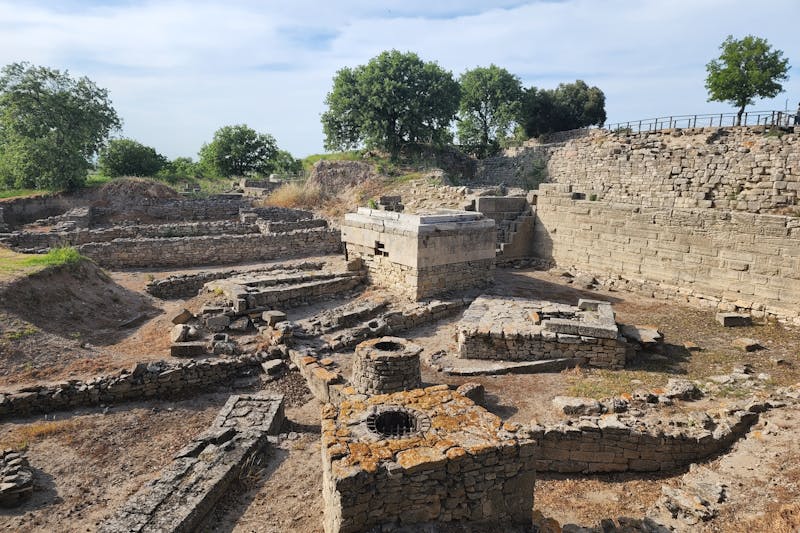
At the point where the Dardanelles Strait meets the Aegean Sea, the quietly rising Hisarlık Hill is home to one of the world's most famous ancient cities: Troy. Immortalized by Homer’s epic Iliad, this ancient city is not merely an archaeological site but also a symbol of thousands of years of wars, loves, and legends. Today, a UNESCO World Heritage Site, Troy invites its visitors on a journey through time.
Where is Troy? The Geography of the Legend
The Ancient City of Troy is located approximately 30 kilometers from the city center of Çanakkale, in Turkey’s northwest. Its precise location is Hisarlık Hill, within the boundaries of Tevfikiye Village. Positioned strategically on the Biga Peninsula, the city overlooks the Dardanelles Strait. In antiquity, this region was known as the Troad, and today it lies on a plain near the foothills of Mount Ida (modern-day Kaz Dağları).
Transportation Guide: Roads to Troy
Reaching Troy is quite easy, and visitors can choose from different transportation alternatives:
1. By Private Vehicle
Travelers starting from Çanakkale center should follow the Çanakkale-İzmir highway. After passing the Kepez area, follow the Troy signs directing you toward Tevfikiye Village. After turning off the main road, a drive of approximately 5 kilometers will bring you to the ancient city. Typing "Troy Ancient City" or "Tevfikiye Village" into your navigation device is sufficient.
2. By Public Transport
For those without a private vehicle, regular minibuses run from Çanakkale city center to the ancient city of Troy. These services become more frequent especially during the summer season, offering an economical and comfortable transportation option.
3. For Visitors Coming from Farther Away
- By Air: Domestic flights operate from Istanbul to Çanakkale Airport. From the airport, you can reach the ancient city by taxi or rental car.
- Organized Tours: Day trips organized especially from Istanbul offer programs that combine Troy with the Gallipoli Historical National Park. These tours typically last around 14 hours and include transportation and guiding services.
Visiting Hours and Entrance Fees
When planning to visit the Ancient City of Troy, having up-to-date information on hours and fees will make your trip easier.
- Visiting Hours: The ancient city is open for visits every day of the week. During the summer season, it is generally open between 08:00 AM and 07:00 PM, while in the winter season, the closing time may be 05:00 PM or 05:30 PM. It is recommended to check official sources for the most current hours.
- Entrance Fees: The entrance fee for foreign visitors is set at 27 Euros. Different rates apply for citizens of the Republic of Turkey and Museum Card holders. Museum Card holders can enter the ancient city free of charge a certain number of times per year (usually twice) or unlimited times with a Museum Card Plus. Since fees are updated periodically, it is advisable to check official websites or ticket booths for current information before your visit.
Must-See Sights in the Ancient City of Troy
When you step into Troy, your first impression will be piles of stones and wall remains. But each of these "piles of stones" tells a story thousands of years old. To truly experience Troy, you must visit the following points:
1. The Trojan Horse Statue (Wooden Horse)
The gigantic Wooden Horse replica greeting you at the entrance of the ancient city is the most important symbol of the Trojan War. This horse, familiar from movies, is a structure you can enter, climb stairs inside, and have the chance to view the ruins from above. While it creates an unforgettable memory especially for children, it is also a powerful symbol that makes the legend tangible for adults.
2. Heinrich Schliemann’s Excavation Areas
The excavations started in the 1870s by the German amateur archaeologist Heinrich Schliemann, who brought Troy to light, represent one of the most controversial but exciting discoveries of the ancient world. Seeing the area where Schliemann found "Priam’s Treasure" is of great importance for understanding both the successes and mistakes of archaeology (Schliemann’s unauthorized and destructive excavation methods). You can still see traces of the large trench Schliemann opened.
3. The Structure of 9 Separate Layers (Troy I-IX)
One of Troy’s most fascinating features is that it consists of 9 different layers built on top of each other. Continuously inhabited from 3000 BCE to 500 CE, this hill is like a layer cake of history:
- Troy I-V: Early Bronze Age village settlements
- Troy VI: Considered Homer’s Troy, the period with powerful fortification walls
- Troy VII: The period of the Trojan War (circa 1250-1180 BCE)
- Troy VIII-IX: Hellenistic and Roman periods
Thanks to the information panels and sections within the site, it is possible to see these layers with your own eyes.
4. The Fortification Walls (Troy VI Walls)
One of the most impressive structures when you think of Troy is the massive fortification walls. These walls, belonging especially to the Troy VI period, reach a height of up to 8 meters in some places. Built from cut stone blocks, these defensive structures demonstrate why Troy could withstand a 10-year siege. The eastern and southeastern sections of the walls are the best-preserved parts.
5. The First Ramp in History
Another unique structure you must see in Troy is the Limestone Ramp, considered the first ramp in history. Located right next to the southern walls, this ramp was built in the 3rd millennium BCE. Although its exact purpose is unknown, it is thought to have been used for military purposes (access to the walls) or for transporting goods. As one of the oldest known ramped structures in the world, it shows how advanced Troy was in engineering.
6. Sacrificial Areas of Important People
The sacred areas and altar remains in the southern part of Troy are points where important figures (kings, heroes, priests) offered sacrifices to the gods in ancient times. Especially these areas, belonging to the Troy VIII-IX periods, are also very close to the area where, according to Homer, Achilles dragged Hector’s body three times around the walls. These areas prove that Troy was not only a battlefield but also a powerful religious center.
7. Troy Museum
Opened in 2018, this modern museum houses thousands of artifacts unearthed from the Troy excavations. With its impressive four-story architecture and interactive exhibitions, it tells visitors the story of the ancient city in all its details. The "Polxena Sarcophagus" and artifacts from various periods are particularly worth seeing.
Practical Information for Visitors
Knowing a few practical details before visiting Troy will make your experience much more enjoyable:
- Little Shade: There are not many trees or shaded areas within the ancient city. Therefore, especially during spring and summer, it is highly recommended to bring a hat, sunscreen, and plenty of water.
- Walking Shoes: The paths within the site can be stony and slippery in places due to the historical texture. Wearing comfortable, sturdy shoes will increase your comfort during your visit.
- Guided Tour: To truly understand Troy’s 9 different layers, fortification walls, ramp, and sacred areas, it is highly recommended to take a tour with a professional guide. Audio guide applications can also be used as an alternative.
- Time Planning: It is recommended to set aside at least 2-3 hours to explore all these important points in detail. Including the museum, this time can extend to half a day.
Troy is not just a ruin of stones; it is the thousand-year-old memory of Anatolia. Discovering this legendary land accompanied by the unique nature of Çanakkale is an unparalleled opportunity to leaf through dusty pages of history. Journey to this ancient city that lives on in Homer’s verses and experience for yourself Troy, which holds a different epic in every stone.