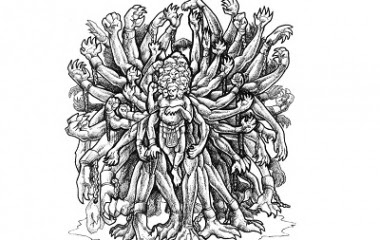
In Greek mythology, the Hecatoncheires, whose name means "hundred-handed ones," are among the most fascinating and powerful creatures of the ancient world. These fifty-headed, hundred-handed giants play a crucial role in mythological tales. Their origins, influence in battles, and historical interpretations make the Hecatoncheires a captivating subject for mythology enthusiasts.
Origins and Characteristics
The Hecatoncheires were the offspring of Uranus (Sky) and Gaia (Earth). They consisted of three brothers:
Briareus (also known as Aigaion)
Cottus
Gyges (sometimes called Gyes)
According to Hesiod's Theogony, when they were born, their father Uranus was horrified by their appearance and imprisoned them deep within Gaia’s womb. Later, when the Titan Cronus overthrew Uranus and seized power, the Hecatoncheires remained imprisoned.
Their Role in the Titanomachy
When Zeus rebelled against his father Cronus, the Hecatoncheires were given a chance to change their fate. Following Gaia’s prophecy, Zeus freed these giants from the depths of Tartarus.
The Titanomachy (War of the Titans): With their hundred arms, the Hecatoncheires hurled massive boulders at the Titans, playing a decisive role in the Olympian gods' victory.
Imprisonment of the Titans: After the war, they assisted in chaining the Titans and imprisoning them in Tartarus.
Some legends also describe their aid to Zeus in his battle against Typhon.
Historical Interpretation: The Euhemerist Perspective
Euhemerus, who interpreted myths as reflections of historical events, suggested that the Hecatoncheires were actually the people of Hecatoncheiria, a city in Macedonia.
Alliance with the Olympians: According to this view, the Hecatoncheires (the city’s warriors) aided the people of Olympia in their war against the Titans and drove them from the region.
Mythological Roots in History: Euhemerus argued that many mythological giants could symbolize powerful armies or tribes in history.
The Hecatoncheires in Art and Literature
Though rarely depicted in ancient Greek vases or Roman art, the Hecatoncheires were usually portrayed as terrifying, multi-armed giants. Their appearance in Dante’s Divine Comedy as guardians of Tartarus shows that these figures were remembered even in the Middle Ages.
The Hecatoncheires are among the most formidable and awe-inspiring creatures in Greek mythology. Their role in the Titanomachy made them architects of Zeus’s victory. At the same time, historical interpretations present them as a mythological reflection of a real-world community. These dual perspectives highlight the profound connection between myth and history in the ancient world.