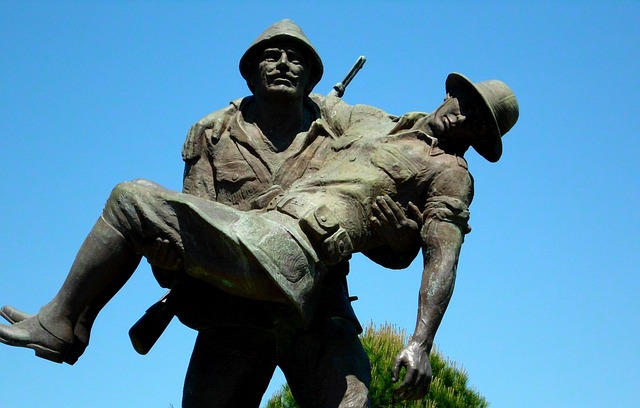
- Gallipoli
They went with courage, they rest with honor. Their memory walks these shores forever.
Here is a short article about the Gallipoli Campaign.
Gallipoli: The Dawn of a National Legend
On a narrow, sun-scorched peninsula in modern-day Turkey, one of the most tragic and transformative campaigns of the First World War unfolded. The Gallipoli Campaign (also known as the Dardanelles Campaign) took place between April 1915 and January 1916. It was conceived as a bold Allied plan to knock the Ottoman Empire out of the war, secure a sea route to Russia, and open a new front in the south. Instead, it became a brutal stalemate defined by heroic charges, impossible terrain, and devastating loss.
The Plan: A Naval Gamble
The architect of the campaign was Winston Churchill, then First Lord of the British Admiralty. He believed that a powerful fleet of British and French warships could force their way through the Dardanelles Strait, bombard the Ottoman capital of Constantinople (Istanbul), and force the empire to surrender. However, when the navy failed to breach the heavily mined and fortified straits in March 1915, the decision was made to land ground troops to destroy the Ottoman artillery. The result was a poorly planned amphibious invasion. On April 25, 1915, a force of British, French, and Australian and New Zealand Army Corps (ANZAC) soldiers came ashore at multiple points on the Gallipoli peninsula.
The Landing and the Stalemate
Instead of a swift victory, the soldiers met a determined and well-led Ottoman defense, commanded by the brilliant Colonel Mustafa Kemal (later known as Atatürk, the founder of modern Turkey).
- At Cape Helles (the tip of the peninsula), British troops landed at "V Beach" under a murderous hail of fire from the fortress of Sedd el Bahr.
- At ANZAC Cove, a few miles north, the Australian and New Zealand troops were landed on the wrong beach. Instead of open plains, they faced impossibly steep cliffs and tangled ravines. They managed to push inland only a short distance before Ottoman counter-attacks, famously ordered by Kemal ("I do not order you to attack, I order you to die"), pinned them down. What followed was eight months of trench warfare worse than the Western Front. Soldiers on both sides endured sweltering summer heat, clouds of flies, dysentery, a lack of fresh water, and the stench of unburied dead. The lines moved only yards. The most famous engagement was the August Offensive, which included the tragic charge of the Australian Light Horse at The Nek, where waves of men were mown down in minutes.
The Evacuation: The Only Success
By the end of 1915, it was clear the campaign had failed. Over 250,000 Allied and Ottoman soldiers had become casualties. Remarkably, the Allied evacuation in December 1915 and January 1916 was a masterpiece of military deception. Troops rigged rifles to fire automatically and quietly slipped away to their ships. Not a single soldier was lost. It was the only well-executed part of the entire campaign.
The Legacy: Birth of Nations
The numbers are staggering: 44,000 Allied soldiers died (including over 8,700 Australians and 2,700 New Zealanders), and an estimated 86,000 Ottoman soldiers perished. But the true legacy of Gallipoli is not military victory—it is national identity.
- For Australia and New Zealand: The campaign marked the first major combat for both nations as independent dominions. The courage, endurance, and "mateship" displayed at Gallipoli became the foundation of the ANZAC legend. April 25, the anniversary of the landings, is ANZAC Day—the most sacred day of national remembrance in both countries, surpassing even Armistice Day.
- For Turkey: The victory at Gallipoli became a defining moment in the birth of the modern Turkish nation. Mustafa Kemal emerged as a national hero, and his famous words to visiting Australian and New Zealand mothers in 1934 remain a testament to shared sacrifice:
"Those heroes that shed their blood and lost their lives... You are now lying in the soil of a friendly country. Therefore rest in peace. There is no difference between the Johnnies and the Mehmets to us where they lie side by side... After having lost their lives on this land they have become our sons as well." Today, the Gallipoli peninsula is a peaceful place of wildflowers and quiet beaches, dotted with cemeteries and monuments. It stands as a powerful reminder that some wars are not won by clever plans, but endured by ordinary people. For the Turks, it is a victory of survival. For the ANZACs, it is a defeat that forged a spirit. And for all of us, it is a place where enemies came to respect each other as brothers.