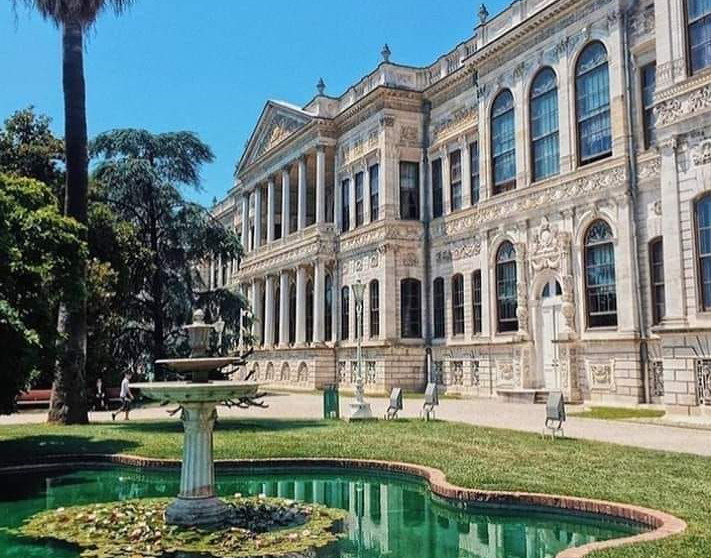

Yıldız Palace
The Architecture of the Palace
Yıldız Palace is not a single monumental structure like Topkapı Palace, but rather a complex spread over approximately 500,000 square meters, consisting of pavilions, mansions, and service buildings that adapt to the slope of the land. This layout is considered an extension of traditional Ottoman palace architecture while also reflecting the eclectic style of the 19th century. The architecture of the palace bears the signature of famous architects of the period, such as the Balyan family (Garabet, Nikoğos, Sarkis) and Raimondo D'Aronco.
One of the most remarkable structures in the complex is the Büyük Mabeyn Köşkü (Grand Mabeyn Mansion), built during the reign of Sultan Abdülaziz (1866). This magnificent two-story masonry building was used for official meetings and receptions during the reign of Abdulhamid II and served as the administrative center of the Ottoman Empire. It draws attention with its staircases featuring crystal railings and its hall with a pool. Another significant structure is the Şale Köşkü (Chalet Mansion), named after the French word "chalet," meaning "mountain house." First built in 1880, the mansion was expanded over time with added sections. The Ceremony Hall, added for the visits of German Emperor Wilhelm II and featuring a floor covered with a single-piece Hereke carpet, is the most ostentatious part of the mansion.
One of the most special places in the palace is the Yıldız Palace Library, which reflects the intellectual personality of Sultan Abdulhamid II. With its two-story, galleried system, woodwork, hand-drawn decorations, and colorful windows, this library, whose appearance is truly mesmerizing, is one of the most original libraries of its era. This place served not only as a book collection but also functioned as the sultan's study and an archive where important state documents (the Yıldız Papers) were kept. Additionally, the Yıldız Palace Theater, built in honor of German Emperor Wilhelm II and holding the distinction of being the only theater located within a palace complex in Turkey, was the center of cultural activities.
The grandeur of the palace forms an integrated whole not only through its architectural design but also through its gardens, consisting of uniquely and carefully cultivated trees, plants, roses, pools, and fountains. These gardens, where the magnificence of the state was displayed, were called the HASBAHÇE (Imperial Garden). The Hasbahçe of Yıldız Palace holds a privileged place not only for its historical and cultural value but also as the last example of Ottoman Palace gardening. One of the most striking features of this garden is the 300-meter-long Hamid Pool, designed to form the silhouette of the word "HAMID" when viewed from above. This elegant manifestation of the Sultan's name reflected in the water, right in the heart of the palace, is the most beautiful proof of what a personal and meaningful place Yıldız was.
From the Sultans' Garden to the Public's Park: Yıldız Park
The grove that served as the outer garden of Yıldız Palace is today one of Istanbul's largest and most beautiful green spaces, known as Yıldız Park. Covering an area of approximately 46.7 hectares, the park is a veritable natural wonder in the middle of the city. It is an ideal place for those wanting to escape the chaos of Istanbul and catch their breath in a quiet corner.
One of the park's greatest riches is its extraordinary plant diversity. Scientific studies show that there are 425 different plant species throughout the Beşiktaş district, the majority of which are concentrated in wooded areas like Yıldız Park. While walking in the shade of century-old trees in the park, it's possible to encounter exotic species as well as native plants unique to the region. With its ponds, water pools, and birdsong, the park is a peaceful oasis offering an escape from the hustle and bustle of Istanbul.
Within the park, two historic mansions inherited from the Ottoman era also welcome visitors. The Malta Köşkü (Malta Mansion), built during the reign of Sultan Abdülaziz, has been arranged for enjoying breakfast or tea on its terrace overlooking the Bosphorus. The Çadır Köşkü (Tent Mansion) from the same period offers a similar service amidst the greenery. Both mansions, once places of rest and entertainment for sultans, are now popular destinations for everyone. These pavilions, where you can get away from the weekend crowds and watch the Bosphorus over a cup of tea, are great alternatives for those who want to see a different part of Istanbul.
In recent years, Yıldız Park has undergone extensive restoration by the Istanbul Metropolitan Municipality. Efforts have been made to reveal the park's original fabric through work carried out in the light of historical documents. In this context, the historical ponds and waterways that had been closed over time were cleaned and made to flow again; the characteristic park railings shaped like tree branches were renewed in accordance with the original; and walking paths and lighting were arranged. Additionally, a historical cemetery area within the park has been protected, and new viewing terraces and an open-air museum have been created.
A Sultan's Secret World: Passion for Detective Novels
Sultan Abdulhamid II was, besides being a statesman, an extraordinary reader and patron of culture. He had a particular passion for detective novels. A dedicated follower of the era's famous detective heroes Sherlock Holmes and Arsène Lupin, the Sultan would have the first Turkish translations of Arthur Conan Doyle's newly published books made immediately. He even invited the author to Istanbul and awarded him the Order of the Medjidie.
The Sultan's interest was so advanced that he would request detective novels be read to him for two to three hours every night before sleep. For this purpose, a special translation department consisting of eight people called Mabeyn mütercimi (translators of the Mabeyn) was established in the palace. This team would immediately translate newly published detective novels from France and England and present them to the Sultan. It is thought that Sultan Abdulhamid II's suspicious nature increased his interest in detective novels. The turmoil during his accession to the throne, Ali Suavi's raid on the palace, and the assassinations of statesmen in Europe at the time may have fueled his interest in the detective genre.
Istanbul University's Rare Works Library holds 523 detective stories translated for the Sultan. Abdulhamid II, whose personal collection is said to contain over six thousand detective novels, has gone down in history not only as a ruler but also as a cultural patron who directed the literature of his time.
| Feature | Yıldız Palace | Yıldız Park |
|---|---|---|
| History | Palace complex whose development began in the late 18th century with Selim III and which served as the state center during the reign of Abdulhamid II (33 years). | The grove, which was the outer garden of Yıldız Palace, was opened to the public in the 1940s. |
| Status | Museum affiliated with the National Palaces Administration (opened to visitors in 2024). | Owned by the Istanbul Metropolitan Municipality, a public park. |
| Main Structures Inside | Büyük Mabeyn Mansion, Küçük Mabeyn Mansion, Chalet Mansion, Cihannüma Mansion, Yıldız Palace Library, Yıldız Palace Theater, Hamidiye Mosque, Imperial Garden (Hasbahçe) and Hamid Pool, various workshops and service buildings. | Malta Mansion, Tent Mansion (Çadır Köşkü), historical ponds and waterways, walking trails, viewing terraces. |
| Visiting | Can be visited as a museum; specific entry hours and fees apply (Domestic: 175 TL, Foreign: 900 TL). Museum Card is valid. | Open every day of the week from 07:00 AM to 12:00 AM. Pedestrian entry is free. |
| Architecture/Atmosphere | Examples of 19th-century Ottoman eclectic architecture. Official and private spaces shedding light on the political and cultural life of the era. Houses a special pool inscribed with the Sultan's name and a rare library. | A peaceful and relaxing atmosphere intertwined with nature, accompanied by century-old trees, ponds, and birdsong. Rest and picnic areas with Bosphorus views. |
Conclusion
Yıldız Palace and Yıldız Park are rare places that fuse Istanbul's multi-layered history and natural beauty in the same crucible. While the magnificent halls and pavilions of the palace whisper the political turmoil, intrigues, and cultural richness of the Ottoman Empire's final years, the park right next to it offers visitors peaceful moments in the shade of its centuries-old trees, accompanied by birdsong. Yıldız is like an oasis, especially for those seeking an escape from the intense pace of city life. The palace, reopened to visitors in 2024, serves as a bridge connecting these two worlds. Whether you wish to journey into the depths of history or simply unwind with a cup of tea overlooking the Bosphorus at the end of the day, Yıldız awaits you. This historical and natural beauty, waiting to be discovered by those tired of always seeing the same places in Istanbul, offers the opportunity to view the city from a completely different perspective.
Last Modification : 4/30/2026 3:45:09 PM