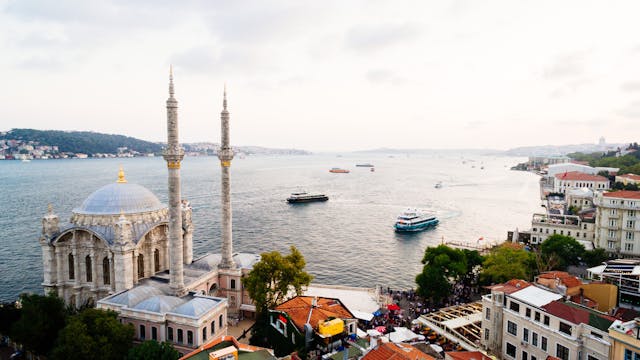
Ortaköy, one of the most vibrant and colorful districts on the Bosphorus, the apple of Istanbul's eye, truly takes its name from its location. Situated at the exact midpoint of the Bosphorus on the European shore, this ancient district has been a crossroads where different cultures, religions, and civilizations have intersected for centuries. However, the story behind the name Ortaköy (literally "Middle Village") is not as old as one might think; it conceals a layered history and an intriguing process of naming shaped by public vernacular.
The Story of Its Name: From Arkheion to Ortaköy
The oldest known name of Ortaköy from the Ancient period is Arkheion. During the Byzantine Empire, the district was known as Klidion (Little Key). However, during the Byzantine era, the district was not only known by these names; it also gained fame as Arsebera or Arsaberu. The origin of this name dates back to an important figure who lived here in the 9th century. It is known that Ioannis VII (Patriarchate 832-842), the Armenian-born Orthodox patriarch, or his brother Arsabarios (Arshavir), owned a magnificent palace within the boundaries of present-day Ortaköy. It was because of this palace that the district was called Arsebera during that period.
However, the fate of this palace was not particularly glorious. Following rumors that secret rituals and immoral entertainments were taking place within the palace, Emperor Basil I purchased the property and converted it into a monastery housing 150 monks. This monastery, dedicated to the Virgin Mary, continued to exist until the final years of the Byzantine Empire.
Another significant religious structure from Ortaköy's Byzantine period was the Great Ayios Fokas Monastery. It is understood that present-day Ortaköy was the location of this great monastery. Unfortunately, the site of this large monastery has not survived to the present day; its traces have been lost. However, the small Ayios Fokas Church, dedicated to the same saint and still standing today, serves as a continuation of this ancient religious tradition.
During the Ottoman period, the district's fate changed with the construction of the elegant mosque built here by Sultan Abdülmecid in 1854. This mosque, the work of the renowned architect Nigoğayos Balyan, began to be referred to as the Mecidiye Mosque in honor of the reigning sultan. Over time, the area surrounding the mosque also came to be known as Mecidiyeköy.
However, the people of Istanbul have always favored practical, colloquial names over official designations. Just as the Sultanahmet Mosque came to be popularly called the "Blue Mosque" due to its blue tiles, and the Bedesten (covered market) became known as the "Grand Bazaar," the Mecidiye Mosque became "Ortaköy Mosque" in common parlance. Subsequently, the surrounding neighborhood and district also took on the name Ortaköy. Although the settlement is officially recorded as Mecidiyeköy, it lives on in the hearts and language of Istanbulites as Ortaköy.
A History of Coexistence: Three Faiths, One Neighborhood
One of the most important features distinguishing Ortaköy from other districts of Istanbul is that for centuries, it has simultaneously been home to members of three major religions. Here, within just a few hundred meters of each other, three different places of worship stand as tangible witnesses to a culture of tolerance and coexistence:
- Ortaköy Mosque (Mecidiye Mosque): The pearl of the Bosphorus, this mosque, one of the finest examples of Neo-Baroque architecture, defines the district's silhouette.
- Ortaköy Armenian Church (Surp Asdvadzadzin): Built in the 19th century, this church has long served as the spiritual center for Ortaköy's Armenian community.
- Etz Ahayim Synagogue: Located in Ortaköy, this synagogue has historically hosted the district's Jewish community, carrying the multicultural fabric of Ortaköy into the present day.
- Ayios Fokas Church: This small church, which bears the traces of the Great Ayios Fokas Monastery from the Byzantine era, remains an important center for the religious life of Ortaköy's Greek Orthodox community.
Today, Ortaköy remains one of the rare districts that honors this heritage, where members of three faiths continue to live side by side, extending hospitality to diverse cultures.
The Transformation with the Bosphorus Bridge
Ortaköy's fate underwent a radical transformation with the opening of the Bosphorus Bridge (July 15th Martyrs Bridge) on October 30, 1973. The placement of one of the bridge's piers directly on the Ortaköy shoreline instantly turned the district into one of Istanbul's most popular attractions. From that day on, thousands of local and foreign visitors eager to take souvenir photos with the bridge began flocking to Ortaköy. Photographs taken under the bridge, in the shadow of this colossal structure, became an iconic postcard image of the district.
Modern Ortaköy: A Hub for Gastronomy and Handicrafts
Today, Ortaköy transforms into what feels like a festival area, especially on weekends. The souvenir stalls lined up along the coast, along with tables selling handmade jewelry, knitted dolls, and local products, create a colorful market atmosphere, particularly showcasing the labor of local women. These stalls contribute significantly to the district's economic and cultural vitality.
When one thinks of Ortaköy, kumpir (stuffed baked potato) undoubtedly comes to mind. This street food delicacy, consisting of a large baked potato loaded with butter, grated cheese, corn, olives, sausages, and dozens of other ingredients, has become synonymous with Ortaköy. Waffle, which has gained popularity in recent years, is another sweet treat frequently enjoyed in the district's cafés.
From Traditional Taverns to Modern Nightlife
Ortaköy's identity is not limited to daytime activities. Once a fishing village famous for its fish taverns, Ortaköy today is also renowned for its nightlife. In recent years, traditional fish restaurants and taverns have largely given way to rooftop nightclubs and upscale restaurants boasting breathtaking Bosphorus views. While Ortaköy presents a calm and refined appearance during the day, it transforms into one of Istanbul's most vibrant entertainment centers as evening falls.
With its narrow streets, historical structures, culture of coexistence, and unparalleled Bosphorus view, Ortaköy is like a microcosm of Istanbul itself. On its journey from Arkheion to Klidion, from Arsebera to Mecidiyeköy, and finally to its present name, this district has carried a distinct character through every era, embracing its past while adapting to the dynamic nature of modern Istanbul. From the ancient traces of the Ayios Fokas Monastery and the 9th-century palace intrigues to the rise of the Mecidiye Mosque in the late Ottoman period and today's modern entertainment venues, Ortaköy has consistently remained one of the most cherished districts of the Bosphorus. Ortaköy continues to be one of the Bosphorus's most special treasures, hosting tourists taking souvenir photos in front of the historic mosque, congregants heading to their church, and young people enjoying nightlife—all in the shadow of the bridge.